
How Can Buyers Verify IPTV Box Quality Before a Bulk Order?
Choosing an IPTV Set Top Box Manufacturer for a large order requires more evidence than a polished sample and a factory tour. Brands, importers, wholesalers, distributors, operators and OEM/ODM buyers need confidence that thousands of units will reproduce the approved configuration with stable hardware, firmware, networking, accessories and packaging. Quality failures are expensive because the purchase price is only one part of the loss: troubleshooting, replacements, freight, channel claims and customer dissatisfaction can cost far more. The correct objective is not to demand that defects never occur, but to verify that the factory has processes capable of detecting variation, containing problems and preventing recurrence. This guide shows procurement teams how to evaluate quality systems from incoming material through pilot production, mass manufacturing and field corrective action before committing significant volume.
Define Quality Before Asking for Quality Control
Quality must be translated into measurable requirements. Define the approved hardware revision, firmware, appearance, interfaces, network functions, remote behavior, accessories, labels and packaging. Without an agreed product definition, inspection becomes subjective.
Ask the IPTV Set Top Box Supplier to convert critical requirements into inspection or test criteria. A statement such as “Wi-Fi must be stable” is weaker than a documented test environment, procedure and acceptance threshold.
Why Is a Golden Sample Not Enough?
A golden sample is useful as a visual and functional reference, but it cannot represent manufacturing variation. It may have been assembled carefully by engineers using selected components rather than normal production processes.
A professional IPTV Set Top Box Manufacturer should connect the approved sample to controlled drawings, BOM, firmware and work instructions. Production must reproduce the documented configuration, not merely resemble one reference unit.
Audit Incoming Material Controls
Incoming inspection should focus on materials whose variation can affect function or reliability. Buyers should understand how PCB assemblies, memory, storage, wireless components, adapters, remotes, enclosures and customized packaging are identified and accepted.
The goal is not necessarily to inspect every characteristic of every part. It is to ensure that approved sources are used, significant defects are detected and questionable material cannot move into production without disposition.
Control the BOM Before Testing Finished Units
Finished-product testing cannot efficiently detect every silent component substitution. Establish approved parts and change-control rules first. Critical changes should trigger engineering review and appropriate revalidation before mass production.
An OEM IPTV Set Top Box Manufacturer should be able to identify which alternatives are prequalified and which require buyer approval. Controlled flexibility protects supply continuity without sacrificing product consistency.
Verify Firmware at the Production Line
Firmware mixing can create units that look identical but behave differently. Each production release should have a unique identifier and be associated with the correct hardware and customer SKU.
Ask the IPTV Set Top Box Manufacturer how flashing stations prevent operators from selecting the wrong image. Final functional testing should verify the installed release so configuration errors are caught before packing.
What Should Functional Testing Cover?
Test coverage should reflect the product. Typical checks may include boot, display output, Ethernet, Wi-Fi, Bluetooth, USB, storage, remote control, audio, applications and standby or wake functions where required.
Production tests should be repeatable and fast enough for line use. More complex performance or compatibility tests can be applied to samples at defined stages rather than attempting laboratory-level validation on every unit.
Test the Network Experience Realistically
IPTV products depend heavily on connectivity, so a simple network connection indicator is insufficient. Engineering validation should examine throughput, stability, reconnection and behavior under representative wired and wireless conditions.
For a Custom IPTV Set Top Box Manufacturer, antenna changes, enclosure modifications and wireless module substitutions should receive targeted retesting because they can change radio performance without altering the visible specification.
Use Video and Application Workloads
Test representative streams, codecs, resolutions and applications required by the project. Include extended playback, seeking, application switching and recovery from common interruptions rather than approving only a short demonstration clip.
Operators should use service-representative workflows where possible. The objective is to verify the integrated experience across hardware, firmware, application and network layers.
Why Does Thermal Validation Matter?
A compact set top box may operate for many hours in warm rooms or restricted spaces. Short functional tests can miss thermal problems that emerge after sustained workload.
Ask the IPTV Set Top Box Manufacturer to evaluate temperature and stability under representative load and ambient conditions. If enclosure, thermal materials or major components change, reassess the relevant thermal behavior.
Do Not Ignore the Power Adapter
An unstable adapter can cause resets or intermittent behavior that users attribute to the box. Verify the approved adapter configuration and prevent unauthorized substitution during purchasing or packing.
Regional variants should also control plug type, cable and labeling. Qualified specialists should determine applicable safety and market requirements for the final product and destination.
What Is the Purpose of Aging or Stress Testing?
Where appropriate to the product and factory process, extended operation can expose intermittent assembly, thermal or component issues that short tests miss. The conditions and duration should have a defined engineering purpose.
More time is not automatically better. Buyers should ask what failure mechanisms a stress process is intended to reveal and how results feed back into corrective action.
Run a Production-Intent Pilot
Before a large Wholesale IPTV Set Top Box order, conduct a pilot using intended materials, firmware, tooling, fixtures, operators and packaging. A pilot is a rehearsal of manufacturing, not another engineering sample round.
Record quantities started, units passing first time, rework, scrap and defect categories. These data reveal process weaknesses that can disappear if management reviews only the final accepted units.
Why First-Pass Yield Matters
A line can eventually produce acceptable units while requiring extensive repair. First-pass yield provides visibility into how consistently the process creates conforming products without rework.
A strong IPTV Set Top Box Manufacturer should investigate recurring failures instead of treating repair as normal production. Improving the process is generally more scalable than expanding a repair station.
Classify Defects by Customer Risk
Not all defects have equal consequences. A cosmetic mark and a device that cannot boot require different priorities. Establish critical, major and minor classifications appropriate to the product and channel.
Classification should be agreed before inspection. This helps procurement, factory quality teams and third-party inspectors apply consistent decisions rather than negotiating severity after defects are discovered.
Use Sampling Plans Intelligently
Lot sampling can provide a structured method for shipment inspection, but it does not replace process control. Buyers should select inspection levels and acceptance criteria according to risk and obtain professional guidance where needed.
Critical safety or configuration characteristics may require controls different from ordinary cosmetic checks. Sampling should complement production testing, traceability and supplier quality management.
Inspect Packaging as Part of Product Quality
Wrong adapters, remotes, labels or manuals can make a technically perfect box commercially unusable. Verify SKU-specific packing lists, artwork revisions, barcodes and carton markings.
For multi-market programs, the IPTV Set Top Box Manufacturer should use clear configuration controls to prevent regional accessories or packaging from being mixed during final assembly.
Build Traceability Before a Failure Occurs
Traceability should connect finished units or batches with relevant production information such as hardware revision, firmware and manufacturing period. The appropriate depth depends on program risk and economics.
When a field problem appears, traceability helps determine whether it affects one lot, one component configuration or the entire product. This can dramatically reduce the scope of containment.
Require Structured Root-Cause Analysis
Replacing a failed unit is containment, not root-cause correction. The factory should reproduce the problem, identify the mechanism, implement corrective action and verify that the action prevents recurrence.
For serious or repeated defects, ask the IPTV Set Top Box Manufacturer for a documented corrective-action process. Evidence should connect the observed failure to the change made rather than simply state that operators were retrained.
Use Field Returns as Engineering Data
Returned units can reveal failure modes that factory tests do not reproduce. Record model, serial or batch information, firmware, symptoms and customer environment whenever practical.
Analyze patterns rather than treating every return independently. A cluster involving one production period, router type or firmware release can direct engineering toward the real cause faster.
Measure Supplier Quality Over Time
Useful indicators can include first-pass yield, shipment defects, repeat failures, corrective-action closure, configuration errors and field-return trends. Metrics should support decisions rather than exist only for reporting.
Review trends jointly with engineering and procurement. A falling defect rate after corrective action is stronger evidence of improvement than a single good inspection report.
Audit Change Management
A stable product can become unstable when components, firmware, PCB, enclosure or test procedures change. Review how changes are requested, evaluated, approved and released into production.
The IPTV Set Top Box Manufacturer should preserve enough revision history to identify what changed between shipments. This is particularly important for repeat orders extending across several years.
Connect Quality Requirements to the Purchase Order
Commercial documents should reference the approved product configuration, inspection criteria and required records where appropriate. Quality expectations that exist only in email conversations are difficult to enforce consistently.
Also define how nonconforming goods, rework and deviations will be handled. A temporary deviation should be documented and limited rather than silently becoming the new standard.
What Should Buyers Approve Before Mass Production?
Before release, confirm the final hardware, firmware, remote, adapter, accessories, packaging, acceptance criteria and pilot results. Review open defects and decide explicitly whether any remaining issue is acceptable.
Selecting an IPTV Set Top Box Manufacturer through this evidence-based process reduces dependence on promises. The buyer gains a documented basis for comparing production results with what was actually approved.
Discuss Quality and Pilot Production With H96 Max
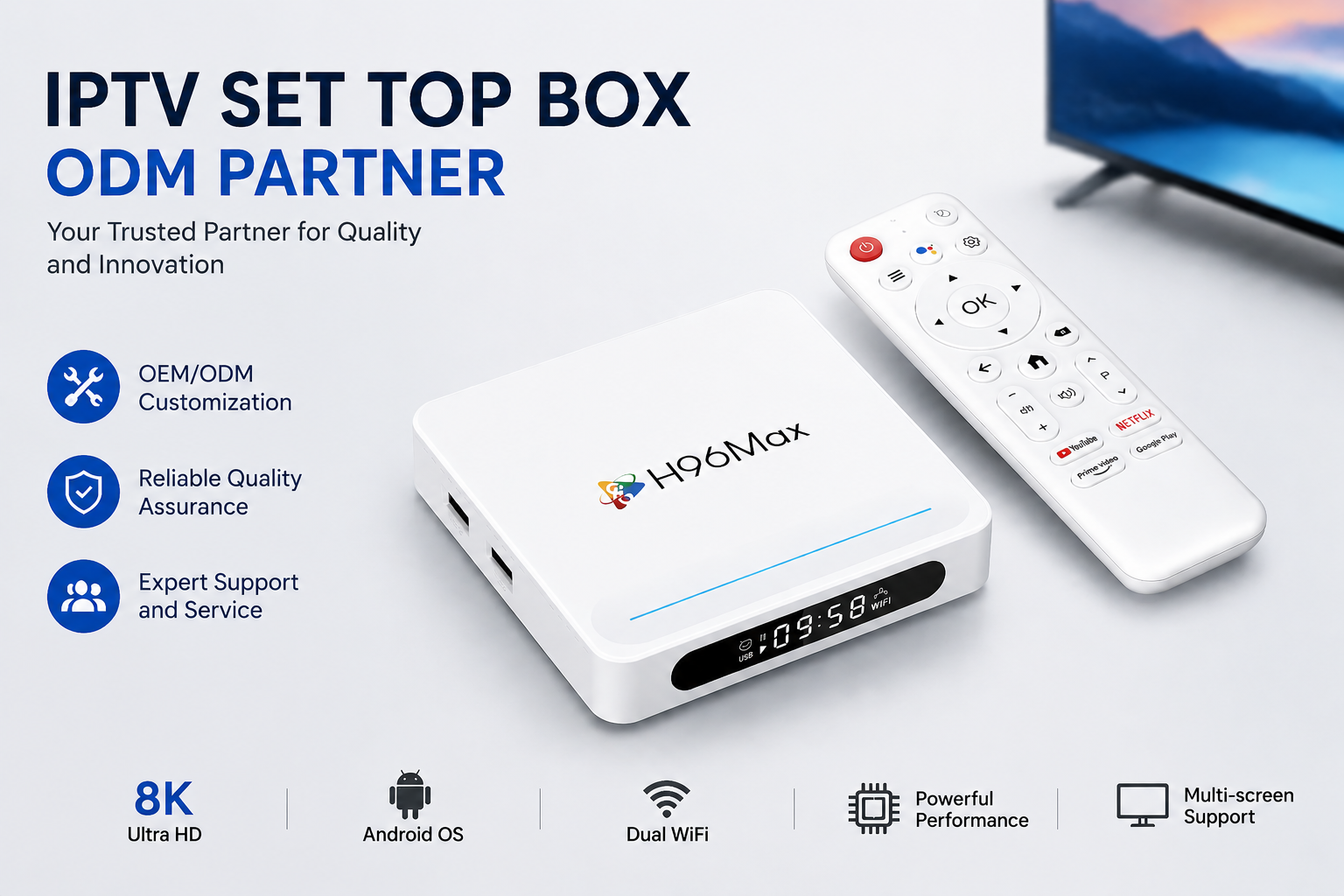
H96 Max is a source factory supporting brands, importers, wholesalers, distributors, operators and OEM/ODM procurement teams. We can discuss IPTV set top box quality requirements, hardware and firmware configuration control, production testing, pilot builds, packaging checks, traceability, defect analysis and repeat-order consistency. Share your target market, service environment, expected volume, customized functions and acceptance priorities so validation can be planned around real deployment risks before bulk production begins. Partner with H96 Max today to explore an IPTV set top box program built around measurable quality requirements, controlled manufacturing and scalable B2B production.
READ MORE
How to Structure an IPTV Set Top Box Manufacturing Agreement for B2B Buyers
How to Manage IPTV Set Top Box Fleets After Large-Scale Deployment
How to Plan IPTV Set Top Box Compliance for International B2B Markets
How to Calculate the True Cost of Bulk IPTV Set Top Box Procurement
How to Reduce IPTV Set Top Box Supply Chain Risk Before Bulk Orders
How to Control IPTV Set Top Box Software Before Mass Deployment
OEM vs ODM: Which IPTV Set Top Box Manufacturing Model Fits Your Business?
How to Choose an IPTV Set Top Box Manufacturer for B2B Procuremen
Quick Links

.png "Watch H96 Max Android TV Box reviews on our YouTube channel")

.png "Explore H96 Max product photos on Instagram")