.png "H96 Max Android TV Box video reviews and tutorials on YouTube")
.png "H96 Max Android TV Box photos and lifestyle shots on Instagram")



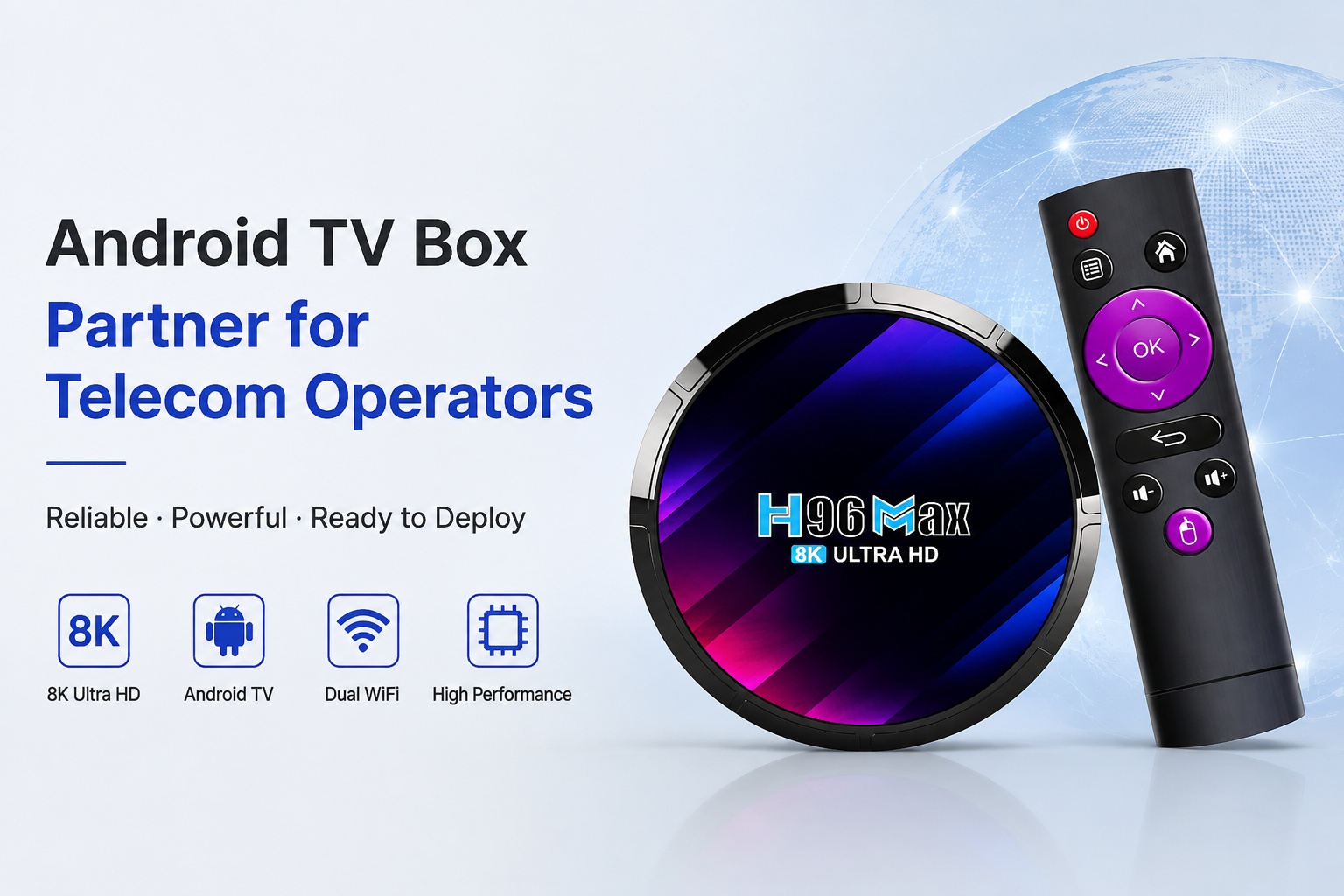
A Telecom Operator’s Guide to Selecting an OTT Media Box Partner
An OTT TV Box Manufacturer serving telecom operators must think beyond retail hardware. Operators need devices that support subscriber experience, service stability, controlled software, logistics predictability, and long-term field support. A consumer can replace one box if it disappoints. An operator may deploy thousands of units across homes, hotels, communities, or bundled broadband packages. That scale changes the sourcing conversation from “Does the box work?” to “Can the device support a managed service?”
Operators buy operational stability
Telecom and ISP buyers often focus on service continuity. The device must be easy to install, consistent across batches, and predictable for support teams. A box that is acceptable for open retail may not be ready for operator deployment if firmware is uncontrolled, settings are confusing, or accessories vary. An OTT TV Box Manufacturer should understand that the operator’s brand is visible every time the subscriber turns on the TV.
The first requirement is a clear deployment model. Will the box be sold, leased, bundled with broadband, used in hospitality, or installed by technicians? Will subscribers install it themselves? Will the operator preload apps, lock the launcher, set default network behavior, or manage updates remotely? A reliable supplier must translate these requirements into hardware, firmware, packaging, and after-sales planning.
An OTT TV Box Supplier that only sends a price list may be useful for basic trade, but operator procurement requires deeper technical alignment. The supplier should know how to document configuration, maintain firmware versions, and support repeat orders without unexpected changes.
Streaming growth raises subscriber expectations
Connected video is now mainstream. DataReportal reported more than 6 billion internet users by late 2025, and TV Technology reported Parks Associates research showing streaming subscriptions reached 91% of U.S. internet households. These numbers matter for operators because subscribers bring mature expectations to every screen. They expect fast setup, smooth navigation, stable Wi-Fi, and clear app access.
Grand View Research estimated the global over-the-top devices and services market at USD 298.84 billion in 2024 and forecast strong growth through 2033. This growth creates opportunity for operators to bundle video, content, broadband, support, and value-added services. But the hardware layer must not become the weak link. If the box fails, the service feels unreliable even when the network is strong.
A serious OTT TV Box Manufacturer should help operators identify which technical features support the service model and which are unnecessary. Operators do not always need the most expensive hardware. They need the configuration that supports subscribers with the lowest operational friction.
Firmware control is the center of operator sourcing
Firmware is more important for operators than for most retail buyers. The operator may need a custom launcher, preloaded apps, default language, boot logo, locked settings, system restrictions, OTA updates, app whitelisting, or device management integration. These requirements should be discussed before sample approval, not added after mass production.
A capable OTT Android Box Manufacturer should provide a clear firmware workflow. Who builds the firmware? Who approves changes? How are bugs documented? Can the same firmware version be maintained across batches? Is OTA available? Can a test group receive updates before full release? Can emergency patches be handled quickly? These questions are not technical decoration. They determine whether the operator can support subscribers efficiently.
Operators should also ask about software legitimacy and privacy. Academic research into connected TV ecosystems has shown that connected viewing platforms can involve complex data flows and tracking questions. An operator should demand clean firmware, authorized app sources, transparent permissions, and responsible update control. Subscriber trust is part of the service contract.
Hardware should match field conditions
Operator devices are used in varied homes and network environments. Some subscribers have strong routers and clean setups. Others place the box behind a TV, inside a cabinet, or far from the router. The hardware should be tested under field-like conditions. Wi-Fi performance, thermal stability, remote response, HDMI compatibility, and power reliability all matter.
An OTT TV Box Factory should provide more than a quick functional test. Operators should ask for aging tests, wireless checks, accessory tests, firmware verification, and production records. The sample should be tested for long playback sessions, reboot behavior, network interruption, standby recovery, and app switching. Field failures become call-center volume, truck rolls, and customer dissatisfaction.
The remote control deserves special attention. For many subscribers, the remote is the product. If keys are confusing, response is slow, or pairing fails, the user blames the service. Operators should confirm key mapping, voice control if required, battery fit, replacement policy, and remote availability for future support.
Packaging and logistics affect deployment speed
Operator packaging is different from retail packaging. It may need clear installation steps, technician labels, serial tracking, MAC address labels, QR codes, accessory organization, and easy carton handling. A beautiful retail box may not be the best choice for field deployment. The right packaging reduces installation time and support calls.
A professional OTT TV Box Manufacturer should help design packaging around deployment. For self-install subscribers, instructions should be simple and visually clear. For technician installation, carton labeling and accessory layout should support speed. For hospitality projects, packaging may need bulk handling and device identification. These details help operators scale without unnecessary friction.
Logistics planning should include spare remotes, adapters, replacement units, and warranty flow. Operators should not wait for failures before designing the after-sales process. The supplier should help define how defective units are diagnosed, replaced, and analyzed.
Security and control cannot be afterthoughts
Operators often need stronger device control than retail brands. This may include locked settings, approved app environments, network behavior rules, and update permissions. If the product is part of a managed service, subscribers should not be able to break the experience easily. At the same time, the device should remain user-friendly.
An OTT Media Box Manufacturer working with operators should understand the balance between control and usability. Too much restriction frustrates users. Too little restriction increases support risk. The right configuration depends on the service model, target audience, content strategy, and support capacity.
Security also includes supply-chain discipline. Components, firmware, and preloaded apps should be traceable. The operator should know what is inside the device and why. If a supplier cannot explain the software package, the operator should not deploy it under its own service brand.
Build the pilot before the rollout
A pilot deployment protects the operator from large-scale surprises. The pilot should include different household types, network conditions, TVs, installation methods, and user profiles. Measure setup time, app stability, Wi-Fi performance, support calls, remote behavior, heat, and subscriber feedback. The goal is not to prove the device is perfect. The goal is to discover fixable problems before volume deployment.
A reliable OTT TV Box Manufacturer should participate in pilot learning. It should review issue logs, adjust firmware, clarify packaging, and recommend hardware changes if needed. A supplier that resists pilot feedback may become difficult during full rollout.
Pilot data should guide final approval. If users struggle with setup, improve the manual or launcher flow. If Wi-Fi complaints appear, review antenna design or installation guidance. If app issues appear, confirm firmware and permissions. Operator sourcing succeeds when feedback becomes controlled improvement.
One overlooked point is procurement timing. Operators often need samples, pilot units, bulk production, spare parts, and replacement batches across a longer schedule than normal retail buyers. The OTT TV Box Manufacturer should be able to discuss this timeline honestly, including component availability and firmware maintenance windows. If the supplier cannot plan beyond the first shipment, the operator carries the risk.
OTT TV Box Wholesale logic also appears in operator procurement because volume pricing must be balanced with deployment stability. The operator may order in stages, but every stage should preserve the same subscriber experience.
Compare suppliers by service readiness
Operators should score suppliers differently from general importers. The scorecard should include firmware control, device management support, hardware stability, accessory consistency, packaging for deployment, compliance awareness, batch documentation, after-sales process, and communication accuracy. Unit price matters, but service readiness matters more.
The best OTT TV Box Manufacturer for an operator is the one that reduces operational uncertainty. It helps the operator provide a smoother subscriber experience, protect the brand, and scale the service with fewer surprises. The weakest supplier may win a quotation but lose the deployment through support cost.
This is where long-term partnership becomes valuable. Operators need roadmap discussions, replacement model planning, firmware maintenance, and predictable supply. A source factory that understands these needs can support more than one purchase order.
For this reason, the OTT TV Box Manufacturer should be evaluated as part of the service infrastructure, not merely as a hardware vendor in planning.
H96 Max works with global project buyers, distributors, and operator-focused customers that need OEM/ODM Android TV box production, firmware adaptation, packaging customization, stable supply, and source-factory coordination. If your operator project requires a device partner that understands deployment risk and subscriber experience, Partner with H96 Max today and build a TV box program ready for scale.
READ MORE
Factory Audit Questions That Reveal the Right TV Box Partner
Good Samples, Bad Shipments: Avoid This OEM TV Box Sourcing Trap
How to Choose an OTT TV Box Manufacturer That Won’t Cost You the Market
Quick Links

.png "Watch H96 Max Android TV Box reviews on our YouTube channel")

.png "Explore H96 Max product photos on Instagram")