.png "H96 Max Android TV Box video reviews and tutorials on YouTube")
.png "H96 Max Android TV Box photos and lifestyle shots on Instagram")



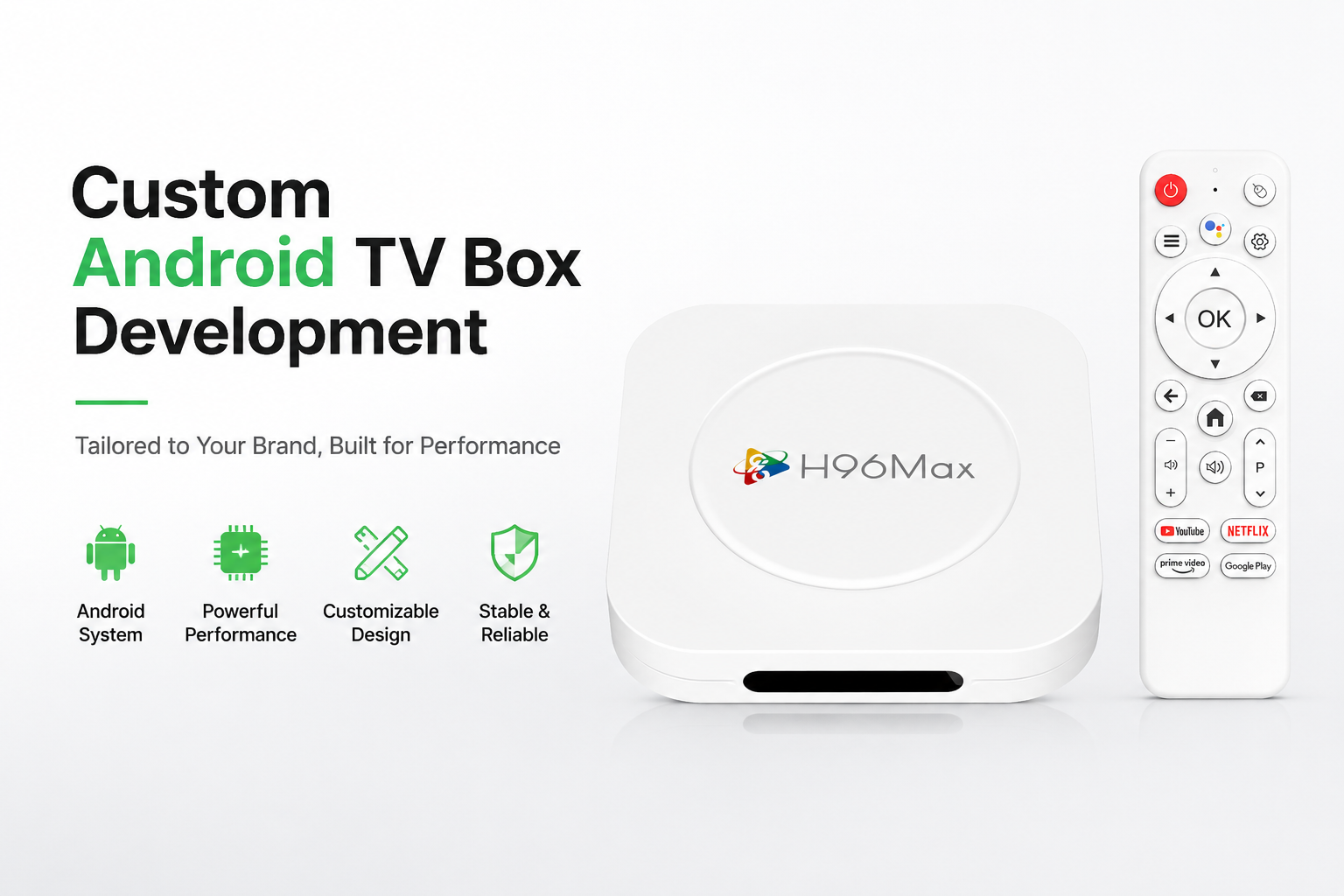
How to Build the Right Hardware Foundation for a Competitive Streaming Device
Custom Smart TV Box development begins with a basic truth: hardware customization is not about adding features one by one. It is about building a device architecture that matches the performance target, use case, user expectations, compliance plan, price band, and long-term service model. For brands, operators, distributors, and enterprise solution providers, the wrong hardware decisions can create slow interfaces, unstable wireless performance, thermal issues, and weak channel confidence. The right decisions create a platform that feels responsive, reliable, and commercially sustainable.
That is why hardware planning should happen as part of a business strategy rather than as an isolated engineering exercise. A tailored streaming device built for retail entertainment may need a different CPU balance, memory profile, remote-control logic, and enclosure strategy than a device used in hospitality, IPTV deployment, digital signage, or enterprise communication. Buyers that understand this early are better positioned to control cost, reduce product risk, and launch a device that fits its market.
Start with the Application Scenario, Not the Spec Sheet
The first step in hardware customization is to define what the device is expected to do in the real world. A streaming box used for mainstream OTT video has one set of requirements. A device intended for operator services may need stronger middleware support, better device management, and stricter stability under continuous use. A box for signage or hospitality may prioritize scheduled uptime, Ethernet consistency, peripheral control, and service-friendly enclosure design. This is why a Custom Smart TV Box Manufacturer should begin the discussion with channel goals, target users, market regions, and content behavior before recommending components.
This approach helps buyers avoid two common mistakes. The first is overspecification, where extra hardware cost adds little customer value. The second is under-specification, where a low opening price leads to sluggish performance, overheating, or poor compatibility. A strong Custom Smart TV Box program should translate commercial needs into a hardware roadmap that balances user experience, supply stability, and margin discipline.
CPU and Chipset Selection: Performance Starts at the Platform Level
The processor is the core of the product architecture because it influences interface speed, app loading, video decoding, graphics behavior, thermal output, and long-term software flexibility. In practice, chipset choice is not simply about buying the fastest platform available. It is about choosing the right level of computing power for the content environment, Android version path, graphics demands, and budget target. A Custom Smart TV Box designed for 4K streaming, heavier multitasking, or richer UI animation may justify a stronger platform than a low-cost entry box aimed at basic playback.
Buyers should look beyond clock speed and core count. Media capabilities, codec support, GPU stability, driver maturity, and software ecosystem support often matter more in deployment. An experienced OEM Smart TV Box Supplier should explain how the selected chipset affects boot time, app responsiveness, DRM compatibility, and firmware maintenance. Long-term supply planning is important too. A platform with uncertain availability can force redesigns later, especially when component substitutions affect compliance or software behavior. For B2B procurement, the best chipset is the one that supports predictable production and user experience.
RAM and Storage: The Real Drivers of Responsiveness and Stability
Memory configuration is often where perceived device quality is won or lost. RAM affects multitasking, launcher smoothness, application switching, and overall UI stability. Storage affects boot consistency, update headroom, app installation flexibility, and lifecycle reliability. A Custom Smart TV Box that looks acceptable on paper can still feel slow in daily use if RAM is too limited for the software design or if storage is too small for app growth and OTA updates.
The right RAM level depends on the operating environment. Basic streaming scenarios may function with modest memory, but richer launchers, account systems, background services, and enterprise controls place more pressure on memory management. Storage strategy should also reflect more than launch-day needs. Once preloaded applications, local data, firmware packages, and future updates are considered, the safe storage requirement is usually higher than early estimates suggest. A Custom Smart TV Box designed with too little storage often creates problems that surface only after units are in the field.
This is one reason serious buyers ask detailed questions about memory brands, storage type, validation conditions, and substitution policy. A reliable partner should clarify whether the quoted design allows alternative components, how compatibility is verified, and what happens if sourcing conditions change. These are key signals for buyers researching How to Choose a Reliable Custom Smart TV Box Manufacturer for Your Business, because stable memory planning is closely tied to field performance and support cost.
Wireless, Ports, and Peripheral Architecture Define Daily Usability
Connectivity decisions have a direct effect on real user satisfaction. In many deployments, buyers focus on processor and memory first, then treat ports and wireless modules as secondary. In practice, these details often determine whether the device performs smoothly in actual homes, hotels, offices, or commercial sites. Wi-Fi standard, antenna design, Bluetooth stability, Ethernet speed, USB layout, HDMI behavior, AV options, and remote-control pairing logic all influence how a Custom Smart TV Box behaves after installation.
Wireless design deserves particular attention because poor signal handling is one of the fastest ways to damage product reputation. Module choice, board layout, shielding, and enclosure material all influence RF performance. These decisions also affect certification scope, especially in markets where FCC and CE testing requirements apply. An experienced Custom Smart TV Box Manufacturer should therefore discuss connectivity architecture early instead of treating it as a late-stage checkbox.
Port strategy should follow the use case. A retail-focused Private Label Smart TV Box may need a clean and simple interface layout for mainstream users, while a professional deployment may require extra USB, optical output, or dedicated recovery access. Peripheral compatibility matters as well. The remote control, power adapter, HDMI cable, and packaging arrangement are part of the hardware experience. If any of these choices are weak, the device can feel low quality even when the core board is capable.
Enclosure, Thermal Design, and Power Architecture Are Business Issues Too
Industrial design is often misunderstood as a cosmetic layer. In reality, enclosure choices affect temperature control, assembly efficiency, durability, RF behavior, repair handling, and perceived quality. A Custom Smart TV Box with attractive specifications can still fail commercially if the housing traps heat, scratches easily, flexes during assembly, or limits antenna performance. Good enclosure design must therefore balance visual identity with production practicality and thermal efficiency.
Thermal engineering is especially important in high-resolution streaming, continuous-use, or signage scenarios. Heat buildup can throttle performance, shorten component life, and create instability that appears only after prolonged operation. Venting strategy, internal layout, heat-dissipation materials, and board spacing all matter. Buyers evaluating Custom Smart TV Box OEM ODM Solutions for Global Brands and IPTV Providers should ask how thermal performance is tested under realistic workload conditions.
Power design should receive the same level of attention. Adapter quality, voltage stability, standby behavior, and protection design affect reliability and certification readiness. In multi-region projects, plug type, adapter sourcing, and labeling control also influence logistics and compliance. These choices often determine whether the product ships smoothly and performs consistently in the field.
Branding Hardware Means More Than Printing a Logo
For many buyers, customization goals extend beyond performance into product identity. But branding should be approached systematically. A Private Label Smart TV Box is more credible when the enclosure finish, LED behavior, remote design, carton structure, and quick-start materials all follow a coherent brand logic. If the external hardware looks generic while the software claims a premium positioning, customers notice the inconsistency immediately.
This is why the user-facing hardware layer deserves strategic planning. Surface texture, logo method, packaging opening experience, cable arrangement, and remote ergonomics all shape first impressions. A thoughtful hardware project uses these elements to support trust. For enterprise or operator channels, even serial-label organization and barcode layout can improve warehouse handling and after-sales tracking.
How Smart Buyers Evaluate Hardware Proposals Before Production
When buyers compare proposals, they should look beyond the component list and ask how the hardware plan supports the full product lifecycle. Key questions include whether the chipset is mature, whether memory and wireless modules have stable sourcing, whether the enclosure supports mass production, whether thermals were tested under sustained load, and whether connectivity decisions align with certification goals. A trustworthy OEM Smart TV Box Supplier will explain trade-offs clearly rather than hiding risk inside a low opening quote.
Sample approval should also be structured. Teams should test boot time, streaming stability, wireless behavior, heat under continuous operation, accessory consistency, packaging integrity, and recovery procedures. It is equally important to confirm how engineering changes are documented and how alternative components would be validated if the supply chain shifts. These operational details often separate a dependable Custom Smart TV Box project from one that looks promising in prototypes but becomes expensive after scale-up.
Final Perspective
Hardware customization works best when it is guided by business logic, validated through realistic testing, and connected to software, branding, and compliance planning. CPU, RAM, storage, connectivity, thermal structure, power design, and enclosure details are not isolated decisions. Together, they determine whether a device can deliver a stable experience, support long-term updates, and protect channel reputation. For brands and operators planning new device programs, H96 Max provides source-factory support across hardware integration, software coordination, branding execution, and scalable production management. The most effective next step is to align the product architecture with the market goal and move forward with a partner that can manage the entire process responsibly. Partner with H96 Max today.
READ MORE
How to Choose a Reliable Smart TV Box ODM Manufacturer for Long-Term Partnership
Smart TV Box ODM Cost Breakdown: How to Control Budget and Maximize ROI
How Custom Smart TV Boxes Help Operators and Brands Increase Revenue
One-Stop Smart TV Box ODM Solutions: Hardware, Software and Branding Integration
Smart TV Box Certification Guide: Google TV, Netflix, CE, FCC and Global Compliance
Android System & UI Customization: Building a Unique Smart TV Experience
From Concept to Mass Production: Complete Smart TV Box ODM Development Process
OEM vs ODM Smart TV Box: Which Business Model Is Better for Your Brand?
Custom Smart TV Box Explained: Why Global Brands Choose OEM/ODM Solutions
Quick Links

.png "Watch H96 Max Android TV Box reviews on our YouTube channel")

.png "Explore H96 Max product photos on Instagram")