.png "H96 Max Android TV Box video reviews and tutorials on YouTube")
.png "H96 Max Android TV Box photos and lifestyle shots on Instagram")



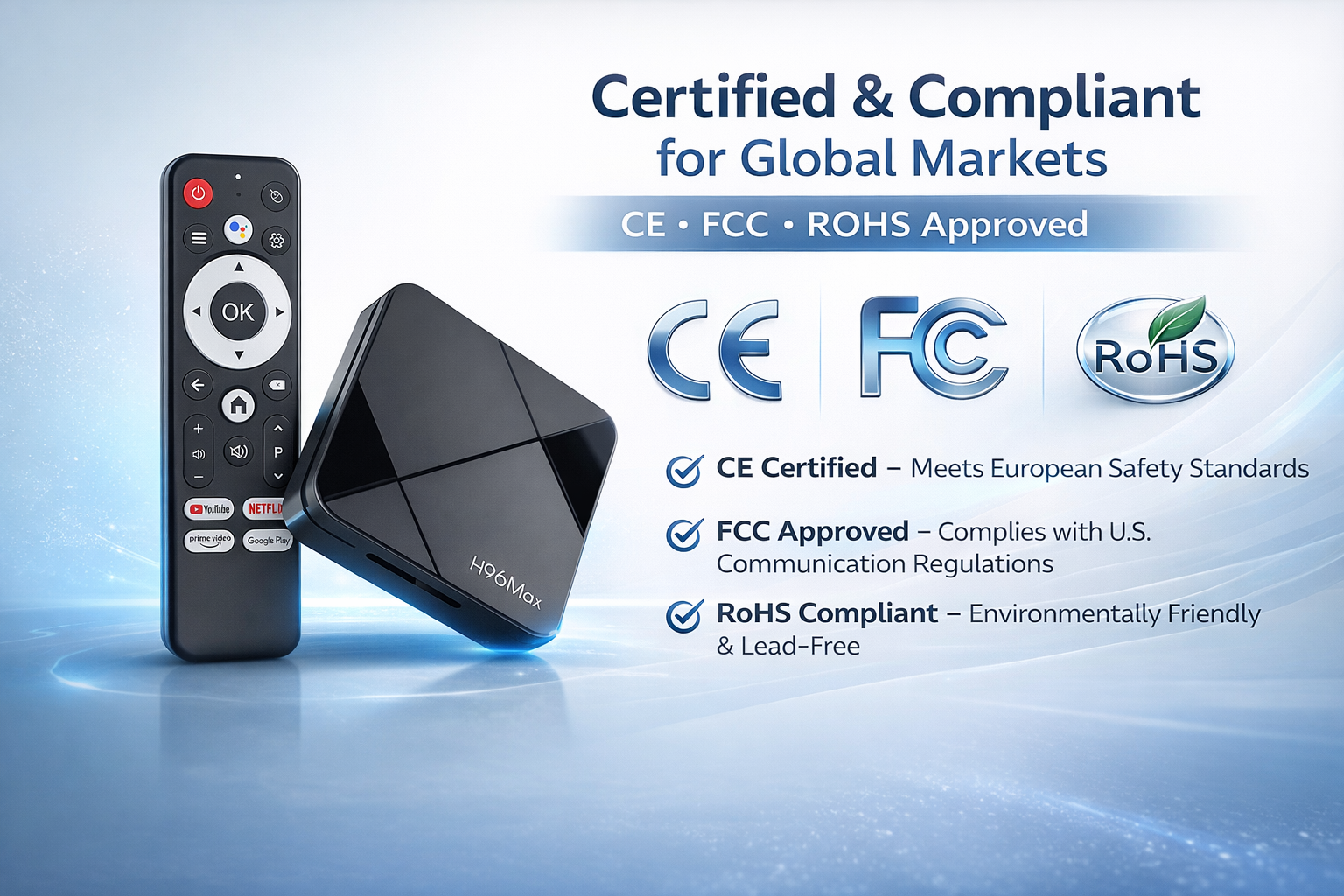
International Compliance Framework for Android TV Box Imports
Android TV Box Certification Requirements are one of the most critical yet misunderstood aspects of cross‑border electronics trade. Importers often prioritize chipset performance, pricing, and branding strategy while overlooking regulatory compliance until a shipment is detained, an Amazon listing is removed, or a distributor demands missing documentation. From an export operations perspective, compliance determines whether a product can legally enter a market, pass customs inspection, and sustain long‑term distribution. Industry compliance reports and global trade analyses consistently rank regulatory violations among the leading causes of electronics shipment delays. Understanding Android TV Box import regulations before production begins is therefore a strategic safeguard rather than a post‑shipment correction.
United States: FCC Authorization and Platform Enforcement
For the United States, FCC certification Android TV Box compliance is mandatory under FCC Part 15 for devices that emit radio frequency energy. Because most Android TV Boxes include WiFi and Bluetooth modules, formal authorization procedures apply. Importers frequently ask, What certifications are required to import Android TV Box to USA and EU? For the U.S. portion, valid FCC documentation is essential prior to customs clearance and commercial distribution. U.S. Customs and Border Protection coordinates with the Federal Communications Commission, and non‑compliant goods may be seized, recalled, or destroyed.
Beyond border control, enforcement increasingly extends to e‑commerce platforms. Sellers commonly raise the question: Do Android TV Boxes need CE and FCC certification for Amazon selling? In the American marketplace, Amazon requires verifiable FCC reports, grant certificates where applicable, and consistent labeling. Mismatched model numbers or expired test reports frequently trigger listing suspensions. From a practical export standpoint, selecting wireless modules with existing modular approval can significantly reduce certification cost, shorten lead time, and lower compliance risk.
European Union: CE Marking, RoHS, and REACH Obligations
Within the European Union, CE certification for Android TV Box products represents conformity with several directives and regulations, including EMC, Low Voltage Directive, and Radio Equipment Directive when wireless functions are present. However, CE marking is not a single test but a conformity framework. Manufacturers must compile a Technical File, issue a Declaration of Conformity, and ensure product labeling meets traceability requirements.
RoHS compliance for TV box devices is equally mandatory, restricting hazardous substances such as lead, mercury, and cadmium in electronic components. Additionally, REACH regulations may impose obligations related to Substances of Very High Concern within supplied materials. European market surveillance authorities have intensified random inspections in recent years. Public compliance statistics from EU enforcement bodies indicate that electronics remain a high‑risk category for documentation inconsistencies. Incomplete Declarations of Conformity, missing harmonized standards references, or incorrect importer addresses are common reasons for customs detention. Effective Android TV Box manufacturer export certification management requires document control procedures integrated into product development rather than handled after mass production.
United Kingdom: UKCA Transition and Dual Documentation
Following Brexit, the United Kingdom introduced the UKCA marking system. Although technically similar to EU CE requirements, UKCA constitutes a separate conformity regime for Great Britain. Importers supplying both EU and UK markets must maintain dual documentation sets and potentially distinct product labeling. Northern Ireland operates under a unique arrangement that may recognize CE under specific conditions, further complicating compliance planning. Exporters who mix CE‑only inventory into UK distribution channels expose themselves to regulatory risk. Advance packaging design and regulatory planning during the production stage help prevent costly relabeling or product rework.
Middle East: SASO, TRA, and Country‑Specific Controls
The Middle East does not operate under a unified certification regime. In Saudi Arabia, SASO approval and SABER platform registration are typically required. In the United Arab Emirates, TRA authorization applies to wireless devices. Other Gulf Cooperation Council countries may impose their own conformity assessment procedures. These processes often require local importer registration and shipment‑specific documentation. Delays frequently arise from incorrect HS code classification or incomplete Arabic labeling.
From an operational standpoint, Android TV Box Certification Requirements in the Middle East should be clarified before production contracts are finalized. Storage charges at destination ports can escalate rapidly if compliance documents are missing or inconsistent. Accurate product manuals, voltage specifications, and safety markings must align precisely with submitted test reports.
Brazil: ANATEL Homologation Complexity
Brazil maintains one of the strictest telecom regulatory environments in Latin America. ANATEL certification is compulsory for wireless‑enabled electronics, including Android TV Boxes. Testing must be conducted in accredited laboratories, and certification requires a locally registered legal representative. Compared to many other regions, approval timelines are longer and compliance costs higher. Exporters must factor amortized certification expenses into pricing models when planning market entry.
Brazilian customs authorities conduct thorough inspections of telecom equipment. Without valid homologation, products cannot legally be commercialized. Coordinating ANATEL certification scheduling with production cycles is therefore essential to avoid warehouse congestion and capital lock‑up.
India: BIS Registration and Expanding Oversight
India requires BIS registration under the Compulsory Registration Scheme for numerous electronics categories. Testing must occur in BIS‑recognized laboratories, and products must carry the Standard Mark. Authorities have also strengthened oversight concerning e‑waste management and battery compliance. Failure to meet BIS requirements can result in immediate import refusal. Importers unfamiliar with local procedural nuances often underestimate document preparation time, leading to repeated queries and resubmissions.
Africa: SONCAP and Certificate of Conformity Programs
Several African markets implement pre‑shipment verification schemes such as SONCAP in Nigeria or broader Certificate of Conformity programs. These systems generally require product testing evidence and inspection before goods depart the exporting country. Without an approved certificate, shipments may remain stranded at port. Android TV Box import regulations in certain African economies evolve frequently, making regulatory monitoring an ongoing necessity rather than a one‑time checklist.
Common Compliance Failures Across Regions
Despite regional differences, recurring compliance failures follow similar patterns. These include inconsistent labeling, outdated test standards, unverified supplier component changes, and mismatched documentation between packaging and reports. Media coverage of electronics recalls in developed markets demonstrates how regulatory lapses can damage brand credibility and distributor trust. Certification should not be viewed solely as a customs requirement but as a risk‑management mechanism protecting long‑term market presence.
Traceability has become increasingly important. Authorities expect clear manufacturer identification, batch control systems, and accessible technical documentation. Integrating compliance verification into the product design and procurement stage strengthens overall supply chain reliability.
Strategic Multi‑Market Certification Planning
For importers targeting multiple jurisdictions simultaneously, a harmonized testing strategy reduces duplicated costs. Designing hardware layouts that anticipate EMC margins, selecting certified power adapters, and aligning documentation templates for CE certification for Android TV Box and FCC certification Android TV Box processes can shorten global launch timelines. Early coordination between engineering, quality control, and regulatory teams ensures smoother cross‑border execution.
Ultimately, Android TV Box Certification Requirements vary by country, but the underlying principle remains constant: documented conformity, consistent labeling, and verifiable technical evidence. Importers who incorporate compliance evaluation into supplier selection significantly reduce customs delays, platform enforcement actions, and distributor disputes. If your organization is planning structured expansion into regulated markets and requires alignment with a factory experienced in multi‑region certification coordination, the H96 Max source factory team can engage in technical discussions to support compliant and sustainable international growth.
READ MORE
What Model Should Beginners Start With When Entering the TV Box Industry?
What Key Questions Should You Ask When Choosing an Android TV Box Supplier?
How to Choose the Right TV Box Model Based on Your Target Market?
How Big Is the Difference Between 2GB+16GB and 4GB+32GB Android TV Boxes?
What Configuration Should You Choose for an IPTV Business Android TV Box?
How to Choose Between Amlogic and Rockchip Solutions for Android TV Boxes?
10 Core Technical Parameters You Must Understand Before Buying Android TV Boxes in Bulk
Quick Links

.png "Watch H96 Max Android TV Box reviews on our YouTube channel")

.png "Explore H96 Max product photos on Instagram")