.png "H96 Max Android TV Box video reviews and tutorials on YouTube")
.png "H96 Max Android TV Box photos and lifestyle shots on Instagram")



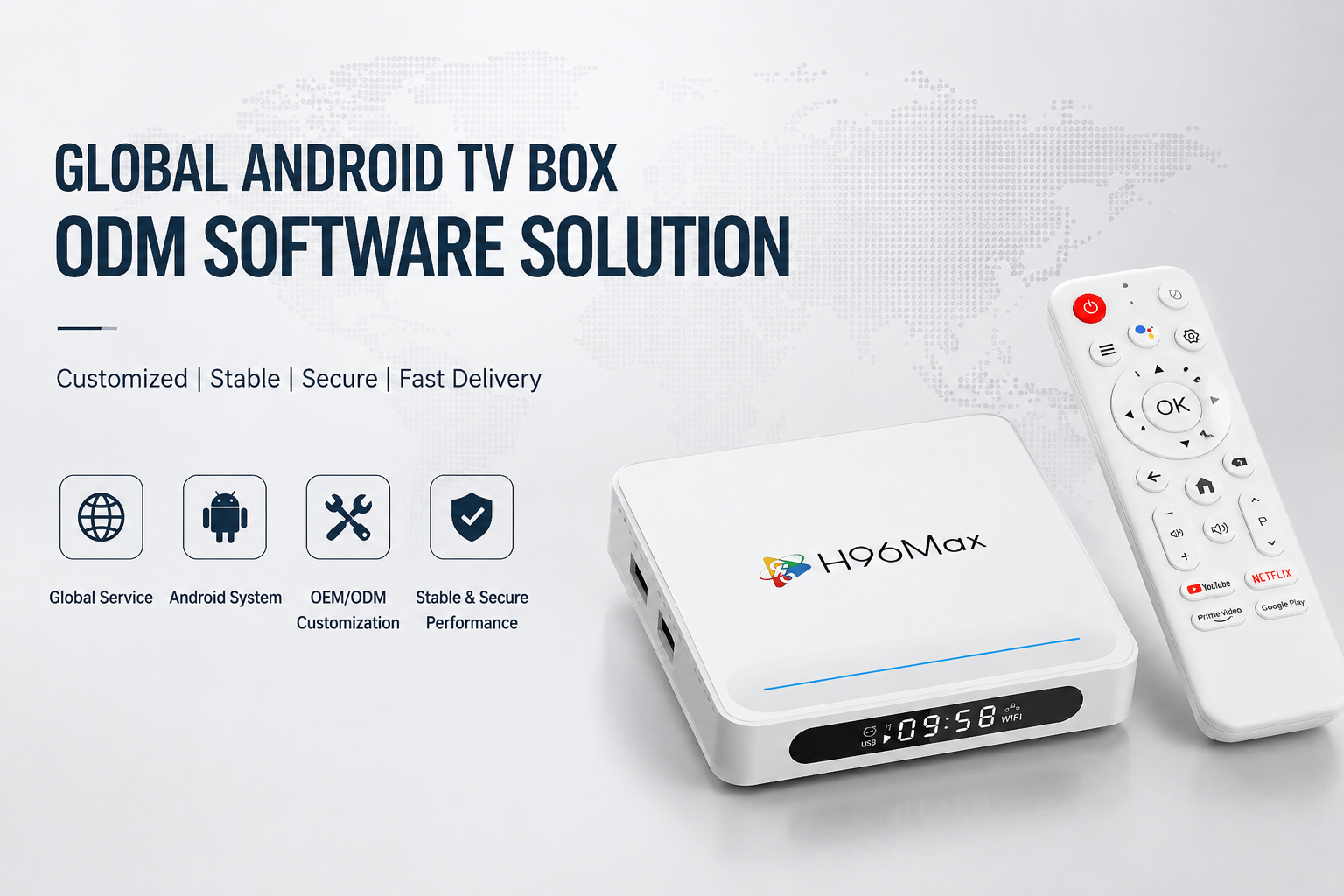
How Much Software Customization Should Your ODM TV Box Really Have?
How much Android TV Box ODM software customization creates a differentiated product without turning every future update into an expensive engineering project? For brands, importers, wholesalers, distributors, operators and OEM/ODM procurement teams, software often creates more visible differentiation than hardware. The launcher, remote behavior, preloaded applications, settings, boot flow, OTA process and device-management functions determine how customers experience the box every day. Yet deeper customization also creates dependencies on Android versions, chipset SDKs, application changes and dedicated regression testing. Buyers should therefore design a software architecture around commercial requirements and lifecycle economics, not around the maximum number of custom features a supplier can demonstrate. The right objective is a maintainable product experience that can be reproduced, updated and supported across repeat orders.
Which Software Layer Actually Needs to Be Different?
Start an Android TV Box ODM software brief by separating branding from functional differentiation. Boot logos, wallpapers and launcher colors are relatively shallow changes. Custom navigation, application policies, settings restrictions, device management and framework modifications create progressively deeper engineering dependencies.
Ask the Android TV Box ODM Manufacturer to classify every requested feature by development depth, maintenance impact and test requirement. A feature that appears simple in a mockup may touch system services or third-party components. This classification helps procurement understand lifecycle cost before approving scope.
What Should the Launcher Accomplish?
The launcher should solve a channel problem. Retail brands may prioritize discovery and recognizable branding, while hospitality or operator deployments may require controlled application access and simplified navigation. An Android TV Box ODM project should define primary user journeys before designers create visual treatments.
Document home-screen hierarchy, application placement, search behavior, settings access and fallback states when connectivity fails. A launcher is successful when users can complete important tasks predictably, not when it simply looks different from the standard interface.
Why Is D-Pad Navigation a Core Requirement?
Television interfaces are normally operated from a distance with directional controls. Google's Android TV design guidance tells developers to support D-pad navigation and design for the “10-foot” viewing experience. For Android TV Box ODM, this makes focus behavior, readability and remote interaction core acceptance criteria.
Test every screen without relying on touch input. Focus should be visible, movement should be logical and users should not become trapped in controls. Custom applications should follow the same navigation model as the launcher so the product feels coherent.
Should the Remote and Launcher Be Developed Together?
Yes. An Android TV Box ODM remote can include infrared, Bluetooth, voice and dedicated application keys. Those choices affect key mapping, pairing, wake behavior and navigation. A software team cannot optimize interaction if the final remote is selected after UI development.
Define short press, long press and special-key behavior where needed. Validate Home, Back, volume and power flows across applications. The remote is effectively the user's controller for the operating system, so hardware and software specifications should remain synchronized.
How Should Preloaded Applications Be Selected?
Every preloaded application adds commercial and technical considerations. An Android TV Box ODM buyer should confirm distribution rights, regional availability, account requirements, update behavior and compatibility. Do not assume that an application can legally or technically be preinstalled merely because it can be downloaded elsewhere.
Prioritize applications that support the target proposition. Excessive preloads consume storage, complicate testing and can make the interface feel cluttered. Maintain an approved application list by region and firmware release.
Can Application Updates Break the Product Experience?
Yes. Third-party applications evolve independently from the Android TV Box ODM firmware. Google Play also advances target API requirements over time, which illustrates why application compatibility is a moving lifecycle issue rather than a one-time launch test.
Identify business-critical applications and create repeatable regression journeys. Record application and firmware versions when defects occur. The factory cannot control third-party code, but it should be able to investigate whether the platform, drivers or custom framework changes contribute to the problem.
How Deep Should Framework Customization Go?
Framework changes can enable specialized behavior, but they increase maintenance. A Custom Android TV Box ODM Solution should modify deeper Android layers only when configuration, launcher logic or applications cannot meet the requirement more cleanly.
Ask engineers what must be rebased when the chipset SDK or Android platform changes. If a feature creates a permanent fork, estimate future integration and regression effort. Procurement should treat custom software branches as lifecycle assets with recurring costs, not free additions to the unit price.
What Is a Production Firmware Baseline?
Every Android TV Box ODM shipment should use an identifiable approved firmware build. The baseline should map to hardware revision, application package, launcher version and relevant configuration. Production work orders should specify that exact build.
A controlled baseline prevents engineers from sending an informal “latest” image to the factory. Release notes should describe meaningful changes and known limitations. Buyers should retain approved images or agreed access arrangements so previous production can be investigated later.
Who Approves a New Firmware Release?
Define approval authority before the first Android TV Box ODM mass-production run. Engineering can prepare a candidate, but product owners should confirm customer-facing behavior and quality teams may need to verify regression results. Critical operator programs can require additional acceptance testing.
Once approved, the build should remain fixed for the relevant order unless a documented change is accepted. Last-minute improvements are risky when they bypass full validation. Stability before shipment is generally more valuable than an unplanned feature.
What Should Regression Testing Cover?
Regression testing for Android TV Box ODM should cover boot, launcher, remote, networking, playback, ports, applications, standby, wake, settings, update and factory reset according to the project. Add workflows tied to the buyer's channel.
Not every release requires identical depth, but critical functions should remain protected. The Android TV Box ODM Service Provider should document test conditions and results so release approval is based on evidence rather than a developer's confidence that the change is small.
What Does a Reliable OTA Architecture Need?
OTA should do more than download a file. An Android TV Box ODM update process needs version targeting, package integrity, controlled release and a defined response to interruption or installation failure. Buyers should understand who operates the update infrastructure and who can authorize deployment.
Where the fleet contains several hardware or customer variants, targeting becomes especially important. Sending firmware to an incompatible board revision can turn a manageable software defect into a large field incident.
Why Should OTA Rollouts Be Staged?
A new Android TV Box ODM build can pass laboratory testing and still encounter unexpected field conditions. Release first to internal devices or a controlled cohort, observe stability and then expand deployment. This limits the population exposed to an undiscovered regression.
Define measurable rollout gates such as successful update rate, boot stability and critical application behavior. Also define who can pause deployment. Staging is particularly valuable for operator or hospitality fleets where simultaneous failure creates high support cost.
What Happens If an Update Fails?
Recovery planning belongs in the original Android TV Box ODM architecture. Test interrupted downloads, corrupted packages, installation errors and unsuccessful boot scenarios. Determine whether the device can retry, roll back, enter recovery mode or require a service procedure.
Evaluate recovery from the customer's perspective. A technically possible method that requires opening the enclosure or using engineering tools may be impractical across thousands of deployed devices. The recovery path should match the channel's service capabilities.
When Does Device Management Become Necessary?
Large commercial deployments may need inventory, configuration, application or update visibility beyond consumer OTA. An Android TV Box ODM buyer should define management requirements based on actual operational tasks rather than requesting a generic dashboard.
An Android TV Box OEM ODM Supplier may integrate customer systems or third-party platforms depending on the project. Define authentication, device identity, permissions, data flows and failure behavior early because management architecture can influence both firmware and backend requirements.
How Should Security Updates Be Planned?
Google publishes Android Security Bulletins describing vulnerabilities and security patch levels. An Android TV Box ODM buyer should ask how the supplier monitors relevant issues and how fixes move through chipset vendors, platform software, integration and regression testing.
Do not assume the factory independently controls every upstream patch. Instead, define responsibility for review, communication and release decisions. The important procurement capability is a repeatable process for evaluating applicable security issues throughout the agreed support period.
Why Does the EU Cyber Resilience Act Matter?
Connected-product obligations are becoming more explicit. The EU Cyber Resilience Act entered into force in December 2024. European Commission guidance states that reporting obligations apply from September 11, 2026 and its main obligations from December 11, 2027. Buyers should obtain qualified advice about applicability.
For an Android TV Box ODM product intended for relevant EU markets, vulnerability handling, update capability, software dependencies and support planning should therefore be considered during development. Compliance cannot be added efficiently if the architecture lacks maintainable update mechanisms.
How Can Buyers Avoid Firmware Fragmentation?
Every additional Android TV Box ODM branch creates another configuration to build, test and maintain. Use a shared core wherever practical and isolate regional branding, application lists or settings through controlled configuration rather than duplicating entire firmware trees.
Maintain a matrix linking commercial SKU, hardware revision and firmware. When a market requests a small change, ask whether the value justifies another branch. Software simplicity improves update speed and reduces the chance of fixing one variant while forgetting another.
What Software Evidence Should a Pilot Run Produce?
During pilot production, verify that the Android TV Box ODM Factory can program the correct image repeatedly, identify versions, run required functional tests and prevent customer configurations from being mixed. Sample devices should match the approved hardware-software combination.
Track programming failures, boot issues and unexpected configuration differences. Pilot production validates not only the software itself but the factory's ability to reproduce it accurately across normal manufacturing conditions.
How Should Field Bugs Be Escalated?
Create a standard defect record containing Android TV Box ODM model, hardware revision, firmware, application version, environment, reproduction steps and severity. Vague reports such as “the box freezes” slow engineering because they do not identify conditions.
Define response priorities for critical, major and minor problems. When a fix is released, verify both the original defect and regression coverage. Field evidence should feed future production so repeat orders do not reproduce known software problems.
How Long Should Software Support Continue?
The appropriate Android TV Box ODM support period depends on deployment and commercial commitments. A short retail SKU and a managed operator product have different lifecycle expectations. Define the intended period before selecting architecture and negotiating development.
Separate defect correction, security maintenance, third-party compatibility work and new features. If some activities require additional engineering fees, document them. A clear support model is more valuable than an unlimited promise that cannot realistically be delivered.
What Does Maintainable ODM Software Look Like?
Maintainable Android TV Box ODM software has a clear architecture, controlled releases, limited fragmentation, repeatable regression tests, staged OTA, practical recovery and defined lifecycle ownership. Customization is concentrated where it creates business value and standardized where differentiation is unnecessary.
For B2B buyers, this approach protects both user experience and total cost. Software should remain an asset after launch rather than become a growing collection of undocumented customer-specific branches that make every future change slower and riskier.
Why Discuss Software Customization With H96 Max?
H96 Max is a source factory supporting brands, importers, wholesalers, distributors, operators and OEM/ODM procurement teams. For an Android TV Box ODM project, our team can discuss launcher and firmware customization, application integration, remote mapping, OTA requirements, hardware-software compatibility, pilot production and repeat-order planning. Share your target markets, critical applications, UI requirements, expected volume and lifecycle expectations so software scope can be reviewed before development is frozen. Partner with H96 Max today to discuss a practical ODM program designed around maintainable software, controlled production and scalable long-term B2B deployment.
READ MORE
What Happens After an Android TV Box ODM Product Goes to Market?
How Can B2B Buyers Keep an Android TV Box ODM Project on Schedule?
What Is the Real Cost of an Android TV Box ODM Project for B2B Buyers?
Can Your Android TV Box ODM Product Meet Global Market Requirements?
Is Your Android TV Box ODM Product Really Ready for Mass Production?
Can Your Android TV Box ODM Supply Chain Survive Component Shortages?
Which Android TV Box ODM Hardware Choices Matter Most to B2B Buyers?
How Do You Verify an Android TV Box ODM Manufacturer Before Ordering?
Do You Really Need Android TV Box ODM for Your Next Product?
Quick Links

.png "Watch H96 Max Android TV Box reviews on our YouTube channel")

.png "Explore H96 Max product photos on Instagram")