.png "H96 Max Android TV Box video reviews and tutorials on YouTube")
.png "H96 Max Android TV Box photos and lifestyle shots on Instagram")



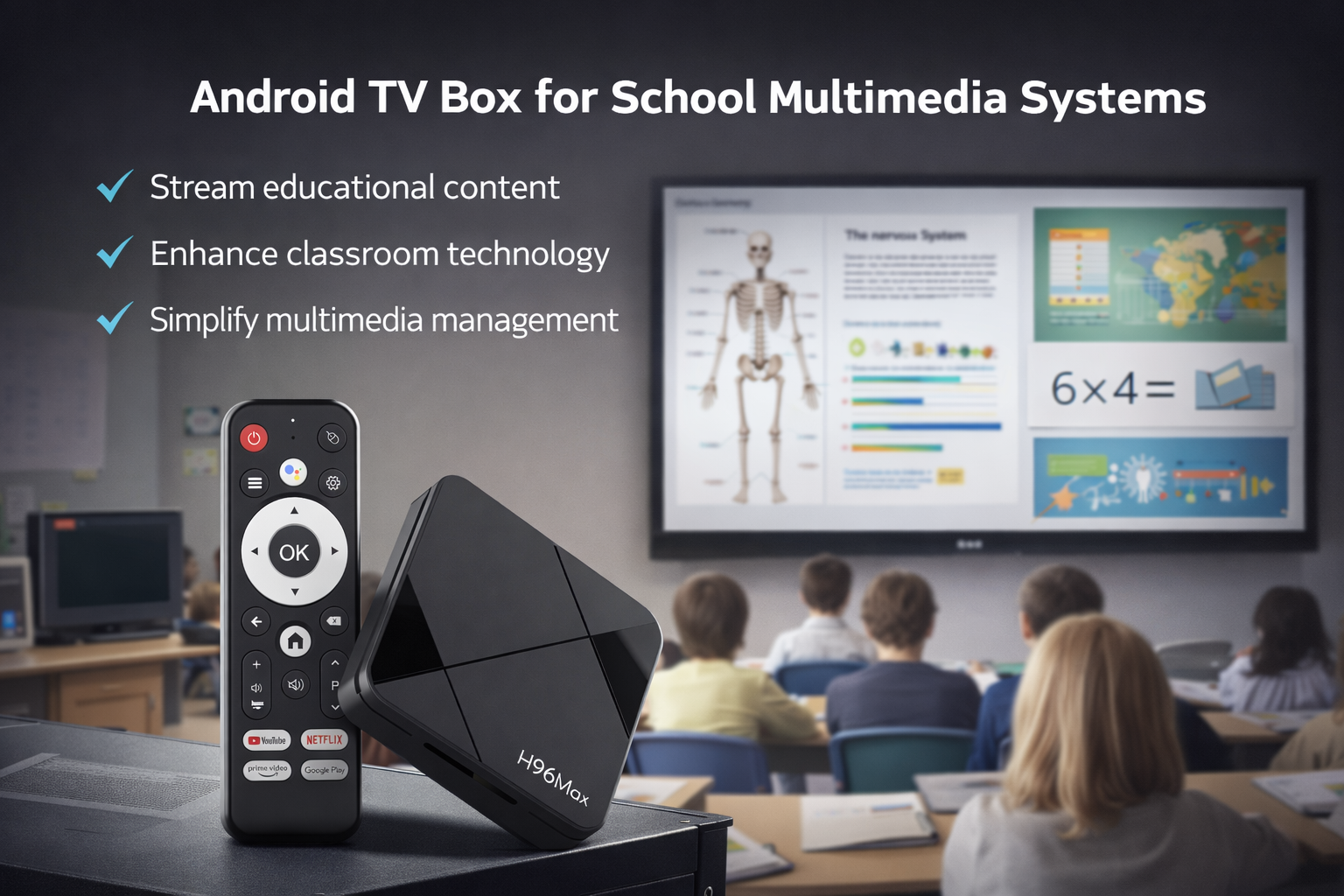
Why Modern Schools Need a Reliable Multimedia Infrastructure
In recent years, digital transformation has reshaped the global education landscape. From hybrid classrooms to fully online learning platforms, institutions are under increasing pressure to deliver high‑quality digital content efficiently. One of the emerging infrastructure tools supporting this shift is the Android TV Box for Education. By connecting classrooms to multimedia content, cloud platforms, and interactive teaching systems, this device has become an essential component of modern learning environments.
Education systems worldwide are investing heavily in digital learning infrastructure. According to UNESCO and the World Bank’s global education technology reports, more than 70% of educational institutions are actively expanding their digital classroom capabilities. However, many schools struggle with unstable playback devices, fragmented device management, and complex deployment costs. These challenges highlight the need for a purpose‑built solution such as an Android TV Box for Education, designed specifically for stable teaching environments.
For administrators, the challenge is not simply displaying videos on a screen. Educational technology must support long‑term scalability, reliable performance, and centralized management across many classrooms. That is why the concept of an integrated Android TV Box Solution for Smart Classroom has gained attention among school IT departments, training institutions, and e‑learning providers.
Understanding the Real Needs of Educational Institutions
To understand why dedicated multimedia hardware is important, it is necessary to look at the operational realities faced by schools and training centers. Classrooms often operate continuously for long hours, sometimes more than eight to ten hours per day. Devices must therefore support long‑term stability and consistent performance without overheating, lagging, or crashing.
Another challenge involves content diversity. Modern lessons include high‑definition video lectures, digital textbooks, streaming platforms, and interactive applications. A reliable Education TV Box must be capable of handling these multimedia workloads without performance degradation. Smooth 4K video playback, stable decoding capabilities, and strong system optimization become fundamental technical requirements.
Schools also demand simplified technology deployment. In many institutions, teachers are not technology specialists. Systems must therefore be intuitive, easy to control, and capable of functioning without complicated setup procedures. This is one reason why many institutions prefer an integrated Android Media Box for Classroom rather than using traditional PC‑based systems that require higher maintenance.
Stable High‑Definition Multimedia Playback
The foundation of digital learning is stable multimedia playback. Educational videos, online lectures, and instructional materials must run smoothly without interruptions that disrupt classroom focus. According to data from the International Society for Technology in Education (ISTE), video‑based learning increases student engagement by over 60%, but technical instability significantly reduces teaching efficiency.
A professional Android TV Box for Education is designed with optimized hardware decoding capabilities, ensuring consistent playback of high‑definition video content. This stability is critical in lecture environments where a single interruption can break the flow of an entire lesson. Compared with consumer streaming devices, a specialized educational system emphasizes reliability and sustained performance.
In addition, educational institutions often rely on recorded courses, digital libraries, and remote learning platforms. A robust Digital Learning TV Box must therefore support multiple streaming protocols and educational media formats to guarantee compatibility with modern teaching ecosystems.
Preinstalled Educational Applications and Learning Platforms
Another key requirement involves software readiness. Many schools deploy standardized teaching platforms, learning management systems, and interactive applications. If devices require manual installation for every classroom, deployment becomes inefficient and difficult to maintain.
A well‑designed Educational Android Media Player allows institutions to preload necessary applications and course content before deployment. This ensures that every classroom device operates with the same configuration, minimizing inconsistencies across the educational environment.
Pre‑installation also improves security and stability. By controlling the installed software environment, IT administrators can reduce risks related to incompatible applications or unauthorized downloads. This controlled system environment makes the Android TV Box for Education far more reliable for institutional use compared with standard consumer devices.
Remote Device Management and OTA System Updates
Managing dozens or even hundreds of classroom devices manually can quickly become overwhelming. IT teams require centralized management tools that allow them to monitor devices, update software, and troubleshoot problems remotely.
Modern smart classroom infrastructure therefore relies on remote device management systems. Through OTA (over‑the‑air) updates, administrators can push system upgrades, install applications, or modify configurations across all devices simultaneously. This capability significantly reduces maintenance costs and operational complexity.
A centralized management platform combined with a reliable Smart Classroom TV Box allows institutions to scale their digital infrastructure without increasing IT workload. According to research published by EdTech Magazine, centralized device management can reduce classroom technology maintenance time by nearly 40 percent.
Screen Casting and Interactive Teaching Support
Interactive teaching is another important trend in modern education. Teachers increasingly rely on screen casting and wireless projection to display presentations, student work, and collaborative materials directly on classroom screens.
A capable multimedia system must support seamless screen mirroring from laptops, tablets, or mobile devices. This functionality enables teachers to quickly share lesson materials without complex cable connections. When integrated properly, an Android TV Box for Education can serve as the central multimedia hub for classroom collaboration.
Interactive learning environments improve knowledge retention and student participation. Studies from the OECD indicate that classrooms integrating interactive digital tools experience measurable improvements in student engagement and comprehension levels.
Unified Device Control Across Campus
Large educational institutions often manage multiple classrooms, lecture halls, and training rooms. Without a unified device management system, maintaining consistent configurations becomes extremely difficult.
A scalable Multimedia Android TV Box for Online Education allows administrators to standardize device settings across entire campuses. Through centralized dashboards, administrators can monitor system status, update course materials, and maintain consistent configurations.
This unified control also simplifies content distribution. Schools can deploy new educational resources across hundreds of classrooms instantly, ensuring that every teacher and student has access to the latest learning materials.
Designed for Long‑Term Continuous Operation
Unlike consumer electronics used intermittently at home, classroom equipment often runs continuously throughout the day. Hardware must therefore be engineered for durability and long‑term reliability.
Thermal management, stable firmware architecture, and optimized hardware components are all critical factors. A professional educational device must withstand extended usage without performance degradation. This is one reason many institutions adopt specialized solutions rather than relying on low‑cost consumer devices.
When designed correctly, the Android TV Box for Education becomes a stable digital infrastructure component supporting classrooms year after year. This reliability ensures that teachers can focus on instruction rather than troubleshooting technology.
The Future of Digital Learning Infrastructure
As digital learning continues to expand, the role of multimedia infrastructure will only grow. Cloud learning platforms, AI‑assisted education tools, and hybrid classrooms are becoming standard in many institutions worldwide.
Within this evolving ecosystem, reliable multimedia hardware acts as the bridge connecting educational content, teachers, and students. Devices such as the Android TV Box for Education help transform traditional classrooms into flexible digital learning environments capable of supporting modern teaching methods.
For institutions evaluating their classroom technology infrastructure, selecting the right hardware partner becomes an important strategic decision. Reliable manufacturing, long‑term product stability, and scalable deployment capabilities all play important roles in ensuring successful digital education projects.
For organizations exploring educational multimedia solutions or large‑scale classroom deployments, collaboration with experienced hardware manufacturers can help ensure that infrastructure decisions align with long‑term digital learning goals. As a source manufacturer of H96 Max devices, we continue to work with global partners developing reliable multimedia systems for modern educational environments.
READ MORE
The Strategy Behind Building a Best-Selling Android TV Box for Amazon
Custom Branded Android TV Box Solutions for the Middle East Market
Custom Android TV Box Solutions for Advertising Media Companies
Hotel-Dedicated Android TV Box Solution for Hospitality Systems
How Cross‑Border Sellers Build Their Own Streaming Device Brand?
Quick Links

.png "Watch H96 Max Android TV Box reviews on our YouTube channel")

.png "Explore H96 Max product photos on Instagram")