.png "H96 Max Android TV Box video reviews and tutorials on YouTube")
.png "H96 Max Android TV Box photos and lifestyle shots on Instagram")



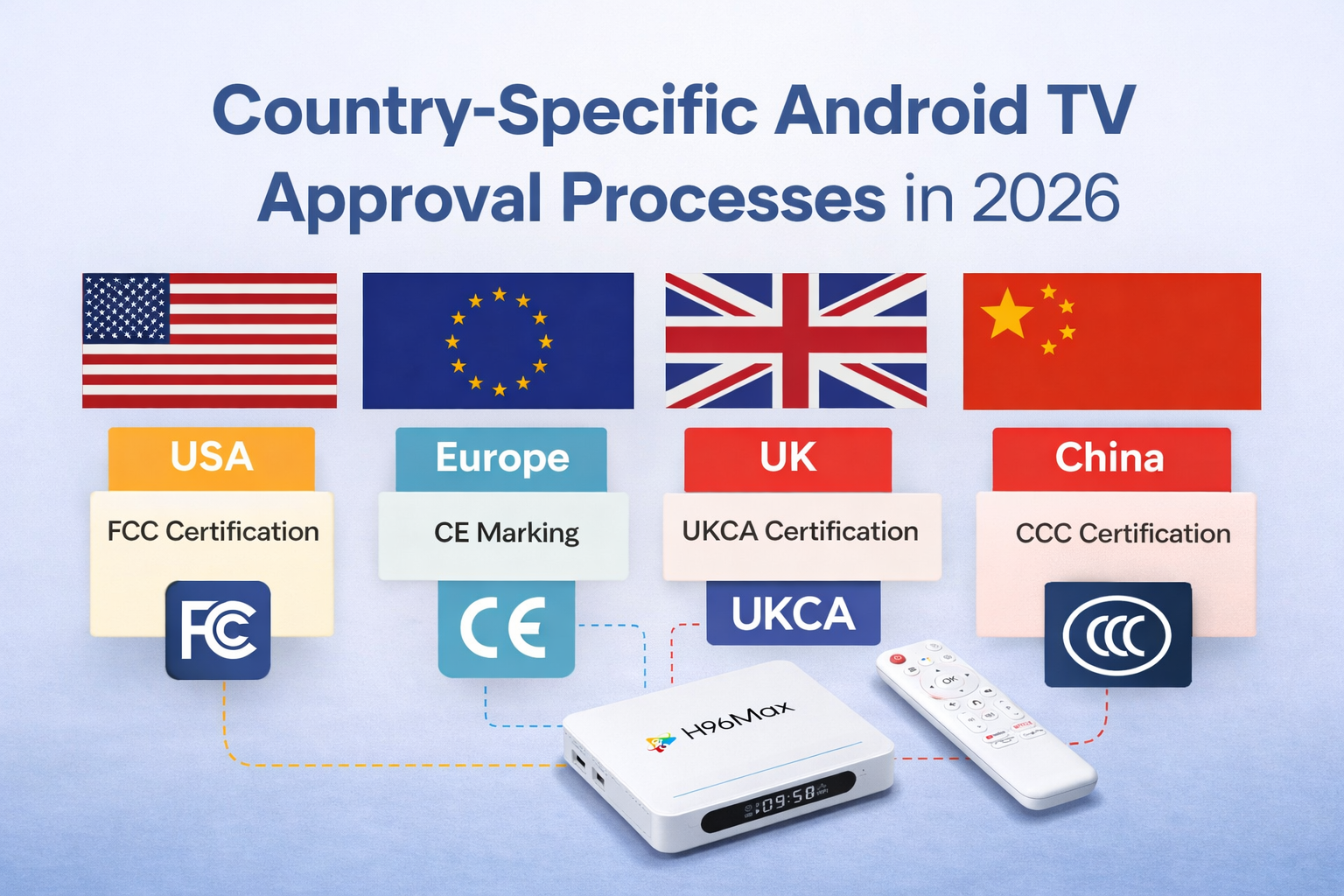
Global Android TV Certification Landscape: Market Access Challenges in 2026
Android TV certification requirements have become one of the most decisive factors influencing whether an Android TV device can legally and successfully enter overseas markets. As global regulators tighten digital governance and Google continues to refine its ecosystem control, manufacturers, brand owners, and operators face a fragmented certification environment that varies significantly by country and region. In 2026, these differences are no longer marginal technical details—they directly determine time-to-market, total compliance cost, and long-term commercial viability.
From the perspective of overseas market access, Android TV is not governed by a single universal approval system. Instead, companies must navigate a layered framework combining Google Android TV certification, national regulatory approvals, and region-specific Android TV compliance requirements. Failure at any level can result in blocked shipments, delayed launches, or permanent exclusion from certain markets.
The Dual Structure of Android TV Certification
At a global level, Android TV certification requirements can be broadly divided into two interdependent layers. The first is Google Android TV certification, which governs access to Google Mobile Services (GMS), Google Play, and the official Android TV user experience. The second layer consists of country-specific regulatory and technical compliance frameworks that address safety, radio frequency, cybersecurity, and content governance.
Industry analysis published by Counterpoint Research and Statista indicates that more than 70% of Android TV box shipment delays in cross-border trade are caused not by hardware issues, but by certification and licensing misalignment. This highlights how Android TV certification by country has become a strategic issue rather than a procedural one.
North America: Compliance Depth Over Speed
In the United States and Canada, Android TV certification requirements are characterized by high regulatory depth and strict enforcement. Beyond Google Android TV certification, products must comply with FCC regulations in the U.S. and ISED requirements in Canada. These cover electromagnetic compatibility, RF exposure, and wireless transmission standards.
Media reports from IEEE Spectrum and regulatory updates from the FCC show that enforcement actions related to uncertified RF modules increased significantly between 2024 and 2025. This trend is expected to continue into 2026, especially as Wi-Fi 6 and Wi-Fi 6E become standard in Android TV boxes.
Europe: Harmonization With Hidden Complexity
Europe is often perceived as a unified market due to CE marking, but Android TV certification requirements for different countries within the EU still present notable variations. While CE certification provides baseline access, additional national requirements—such as energy efficiency labeling, eco-design directives, and data protection enforcement under GDPR—introduce complexity.
According to reports by the European Commission and TÜV Rheinland, Android TV compliance requirements related to power consumption and standby energy usage are among the most common reasons for certification delays in Europe. These technical constraints directly influence chipset selection, firmware optimization, and system-level power management strategies.
India and Southeast Asia: Rapid Growth, Fragmented Rules
India and Southeast Asia represent some of the fastest-growing Android TV markets globally, yet they also exhibit some of the most fragmented certification landscapes. Android TV certification by country in this region often combines Google certification with locally enforced safety, import, and content rules.
In India, the Bureau of Indian Standards (BIS) certification is mandatory for Android TV boxes, while additional scrutiny applies to encryption, data storage, and content accessibility. Industry data from RedSeer Consulting suggests that certification timelines in India can vary by up to 40% depending on local testing lab availability and documentation quality.
Middle East and Latin America: Regulatory Acceleration
Historically considered lower-barrier regions, the Middle East and Latin America are rapidly strengthening Android TV compliance requirements. Countries such as Saudi Arabia, the UAE, Brazil, and Mexico have introduced new conformity assessment procedures tied to cybersecurity, wireless standards, and energy regulation.
Research published by GSMA Intelligence indicates that regulators in these regions increasingly align Android TV box certification requirements with telecom infrastructure policies. This creates additional layers of approval beyond consumer electronics standards, particularly for IPTV-focused Android TV devices.
Why Certification Strategy Determines Commercial Success
Across all regions, a clear pattern emerges: Android TV certification is no longer a checkbox process. It is a strategic market entry decision that affects cost structure, launch timing, and brand credibility.
Authoritative commentary from Android Authority and ABI Research consistently emphasizes that brands failing to plan certification holistically face higher long-term risks than those investing upfront in compliance architecture. This includes aligning hardware design, OS configuration, and documentation workflows with both Google Android TV certification and country-specific Android TV compliance requirements.
Looking Ahead to 2026
By 2026, Android TV certification requirements are expected to become even more differentiated by region. Regulatory focus is shifting toward cybersecurity resilience, AI-driven content recommendation transparency, and lifecycle sustainability. These trends will further widen the gap between compliant and non-compliant market participants.
Industry consensus from IHS Markit and Deloitte technology outlook reports suggests that companies treating certification as an afterthought will face diminishing access to high-value markets. Conversely, those integrating certification strategy into product planning will gain structural advantages in global expansion.
Final Perspective
Understanding Android TV certification requirements from an overseas market access perspective is no longer optional—it is fundamental. The differences in Android TV certification by country, combined with evolving Google Android TV certification policies, demand a level of regulatory literacy that matches technical expertise.
For companies navigating this landscape in 2026, the most valuable partners are not those who promise speed, but those who understand compliance depth, regional nuance, and long-term certification sustainability. If your team is evaluating compliant Android TV manufacturing pathways or seeking a stable, certification-ready production foundation, you are welcome to connect with H96 Max, a source factory experienced in supporting global Android TV compliance and OEM collaboration.
READ MORE
Real Demand for Android TV Box System Versions in Overseas Markets in 2026
2026 Overseas Telecom Operator Customized Android TV Box Trend Analysis
Is the India Android TV Box Market Still Worth Entering in 2026?
Android TV Box Price Range Analysis in Southeast Asia for 2026
2026 EU Android TV Box Market Entry Barriers: In-Depth Analysis
Top-Selling Android TV Box Configurations in Latin America for 2026
Specification Preferences in the 2026 Middle East Android TV Box Market
2026 Opportunities and Risks Analysis of the Android TV Box Market in Africa
Quick Links

.png "Watch H96 Max Android TV Box reviews on our YouTube channel")

.png "Explore H96 Max product photos on Instagram")