.png "H96 Max Android TV Box video reviews and tutorials on YouTube")
.png "H96 Max Android TV Box photos and lifestyle shots on Instagram")



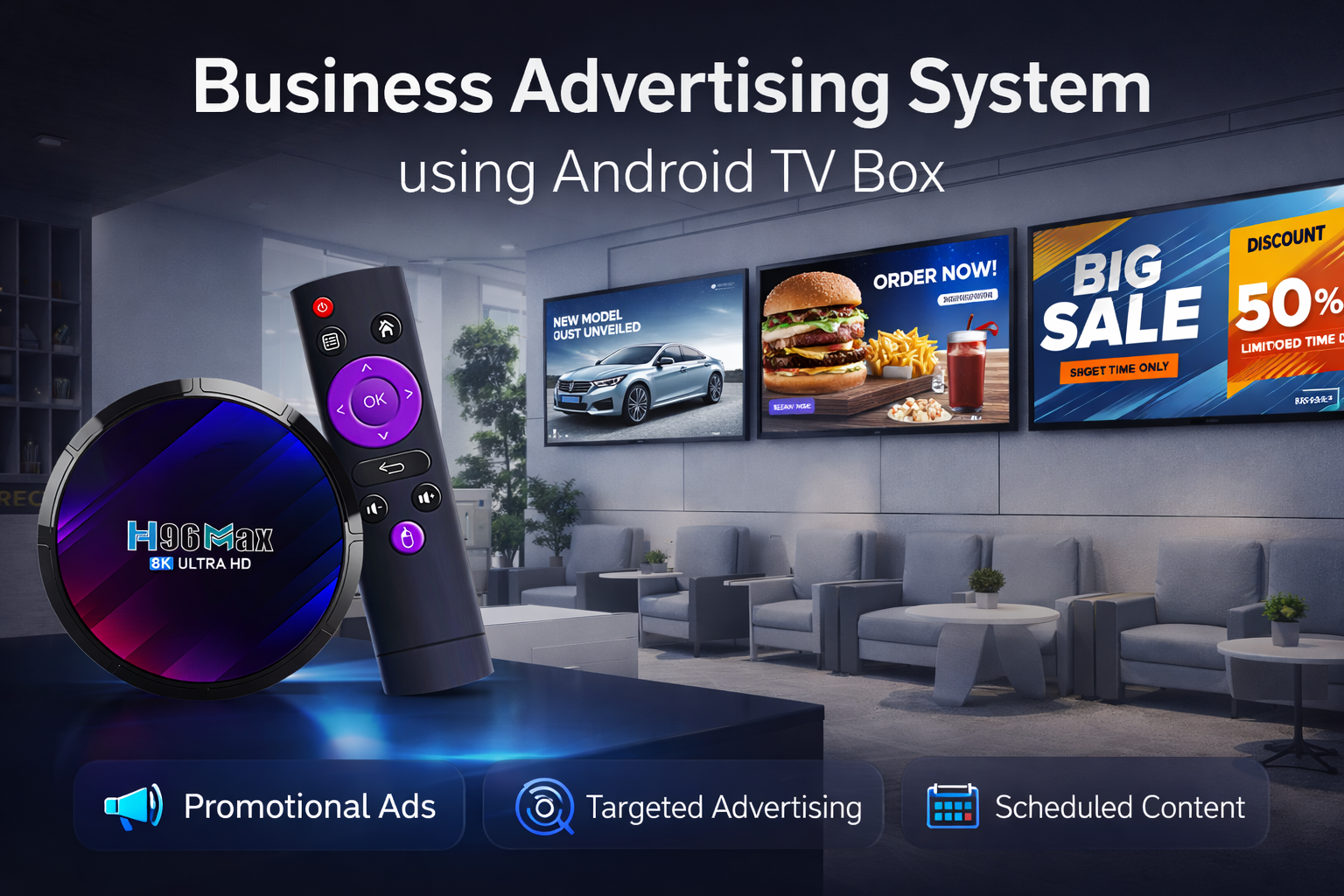
Why Android TV Boxes Are Transforming Digital Signage Advertising Networks
In recent years, the Android TV Box for Digital Signage has emerged as a practical infrastructure component for building scalable advertising display networks. As digital media replaces static posters and printed billboards, media operators and advertising agencies face a new challenge: deploying and managing hundreds or even thousands of screens efficiently. Traditional digital signage hardware has historically been expensive, complex to maintain, and difficult to scale. Android-based media devices have changed that equation by offering a flexible, low-cost computing platform capable of delivering high‑resolution multimedia content across distributed display networks.
From shopping malls and transportation hubs to restaurants and retail chains, digital signage has become a dominant communication channel. According to research published by Grand View Research, the global digital signage market is expected to exceed 45 billion USD within the next few years, driven largely by the expansion of programmatic advertising and smart retail environments. Within this ecosystem, lightweight computing devices such as the Android digital signage player are increasingly being used to power displays because they combine familiar operating systems, strong multimedia support, and efficient remote management capabilities.
The Growing Demand for Scalable Advertising Display Infrastructure
Digital signage networks must satisfy several operational requirements simultaneously. Advertising operators need reliable media playback, flexible scheduling, remote device monitoring, and the ability to update campaigns instantly across multiple geographic locations. Historically, specialized industrial PCs were used as signage controllers, but these systems often carried high hardware costs and complicated maintenance procedures.
The emergence of the Android TV box for advertising display offers a simpler alternative. These devices integrate GPU acceleration, multimedia decoding, wireless connectivity, and application support into a compact system capable of driving modern commercial displays. Because Android is a widely adopted platform, software developers can easily build signage management applications and content distribution platforms on top of it.
For media companies building regional or national advertising networks, scalability becomes the defining factor. Deploying hundreds of screens across retail stores or transportation systems requires hardware that is easy to install and simple to manage remotely. This is one of the main reasons why the digital signage media player Android ecosystem has gained strong adoption in recent years.
Cost Efficiency Compared With Traditional Signage Hardware
One of the most important advantages of the Android TV Box for Digital Signage is cost efficiency. Traditional commercial signage PCs can cost several hundred dollars per device, not including installation and configuration expenses. When a network requires hundreds of screens, hardware costs alone can quickly become a major investment barrier.
Android-based media players significantly reduce this barrier. Because they are built on mobile chipsets designed for high‑volume consumer electronics, they benefit from economies of scale that dramatically lower hardware costs. At the same time, modern chipsets provide hardware decoding for 4K video, advanced graphics acceleration, and stable operating systems capable of continuous playback.
Industry analysts from MarketsandMarkets have noted that cost reduction is one of the main drivers accelerating the adoption of Android advertising display box devices in commercial environments. Lower device costs allow advertising networks to expand faster, install more screens, and experiment with new locations without committing to large upfront infrastructure investments.
Simplified Deployment and Installation
Another key advantage lies in deployment simplicity. Traditional signage PCs often require specialized configuration, operating system installation, and integration with display drivers. This complexity increases installation time and requires trained technical staff.
By contrast, an Android digital signage player can typically be installed within minutes. The device connects directly to the display through HDMI, joins the network through Wi‑Fi or Ethernet, and launches the signage management application. Because Android systems support automatic updates and application distribution, software deployment can also be centralized through cloud management platforms.
For companies researching how to build a digital signage network with Android TV box devices, this simplicity becomes especially valuable. A technician can install dozens of displays in a single day without complex configuration processes, which dramatically accelerates network rollout.
Remote Content Management and Real‑Time Updates
Content flexibility is another reason why the Android TV Box for Digital Signage has become popular among advertising operators. Digital signage networks depend on the ability to update advertising campaigns instantly. Restaurants may change menu promotions daily, retailers may update seasonal campaigns weekly, and transportation hubs may display real‑time information continuously.
Android-based signage systems integrate easily with cloud‑based content management systems (CMS). These platforms allow operators to upload media, create playlists, schedule advertising campaigns, and distribute content across hundreds of screens simultaneously. As soon as a campaign is updated in the CMS platform, the connected players automatically download and display the new content.
This capability is particularly important for programmatic advertising networks where campaigns change frequently. Instead of manually updating each display, operators can manage the entire network from a centralized dashboard. The digital signage media player Android architecture therefore reduces operational complexity while enabling faster advertising response cycles.
Scheduled Playback and Audience Targeting
Advertising effectiveness depends not only on display quality but also on timing. Modern digital signage systems allow campaigns to be scheduled according to specific time windows, audience patterns, or geographic locations. For example, breakfast promotions can run in the morning while entertainment advertisements appear in the evening.
Android signage systems support advanced scheduling through software management platforms. Using an Android TV box for advertising display, operators can assign playlists based on time, day, or location. This flexibility improves campaign performance and ensures advertising content reaches the right audience at the right moment.
In addition, modern signage software platforms can integrate analytics tools that measure screen uptime, playback reliability, and viewer engagement metrics. These insights help media companies refine advertising strategies and improve return on investment.
Centralized Device Monitoring and Network Stability
Managing a large display network requires continuous monitoring of device status. If a screen stops playing content or loses network connectivity, advertising revenue may be affected. Centralized monitoring tools therefore play a crucial role in maintaining network reliability.
Many Android signage platforms include device management dashboards that allow operators to monitor every connected Android TV Box for Digital Signage unit in real time. System administrators can check device health, storage status, network connectivity, and playback logs from a single interface. If an issue occurs, remote troubleshooting can often resolve the problem without sending technicians to the site.
Because Android systems are widely supported by developers and hardware manufacturers, firmware updates and security patches can also be distributed efficiently across the network. This reduces long‑term maintenance costs and ensures consistent performance across multiple installations.
Industry Recognition and Market Adoption
Several industry reports highlight the increasing adoption of Android-based signage hardware. Research from Future Market Insights indicates that cloud‑connected signage players are among the fastest‑growing segments of the digital signage industry. The combination of affordable hardware and cloud software platforms has significantly lowered the technical barrier for launching advertising networks.
As a result, many technology integrators now consider Android hardware to be among the best Android TV box for digital signage advertising deployments, particularly for retail environments, restaurants, education institutions, and transportation networks.
Manufacturers also offer customization capabilities through Android TV Box ODM services, allowing network operators to integrate specific firmware, branding elements, or application ecosystems tailored to their business models. This flexibility further accelerates adoption across global markets.
A Practical Foundation for Modern Advertising Networks
The transformation of advertising from static print to dynamic digital media requires infrastructure that is scalable, flexible, and cost‑efficient. The Android TV Box for Digital Signage fulfills these requirements by combining multimedia performance, remote management, and simplified deployment into a compact device.
For media companies, retail chains, and technology integrators, Android-based signage players provide a practical foundation for building large‑scale advertising networks without the complexity of traditional signage computers. As digital communication continues to expand across physical spaces, these devices will likely remain a central component of modern display ecosystems.
Organizations exploring digital signage infrastructure often begin by evaluating hardware platforms capable of supporting reliable long‑term playback and centralized management. In many cases, this evaluation naturally leads to Android-based players due to their balance of cost, performance, and software compatibility.
For companies interested in collaborating with experienced hardware manufacturers, working directly with an original device factory can also provide advantages such as product customization, firmware optimization, and large‑scale supply capabilities. Teams exploring partnership opportunities in this space are welcome to connect with the H96 Max source factory to discuss potential cooperation in Android signage hardware development and manufacturing.
READ MORE
How Can Enterprises Build an Internal TV System Using Android TV Boxes?
How Can Education Platforms Build a Teaching System Using an Android TV Box?
How Telecom Operators Customize Android TV Box Systems for IPTV Platforms?
How to Build a Profitable IPTV Business with Android TV Box?
How Amazon Sellers Build a Profitable Private Label Android TV Box Brand?
How to Start a Profitable Android TV Box Distribution Business?
Why OTT Platforms Are Turning to Customized Android TV Hardware?
How to Start a Profitable IPTV Box Business in Africa: A Practical Market Guide
Quick Links

.png "Watch H96 Max Android TV Box reviews on our YouTube channel")

.png "Explore H96 Max product photos on Instagram")