.png "H96 Max Android TV Box video reviews and tutorials on YouTube")
.png "H96 Max Android TV Box photos and lifestyle shots on Instagram")



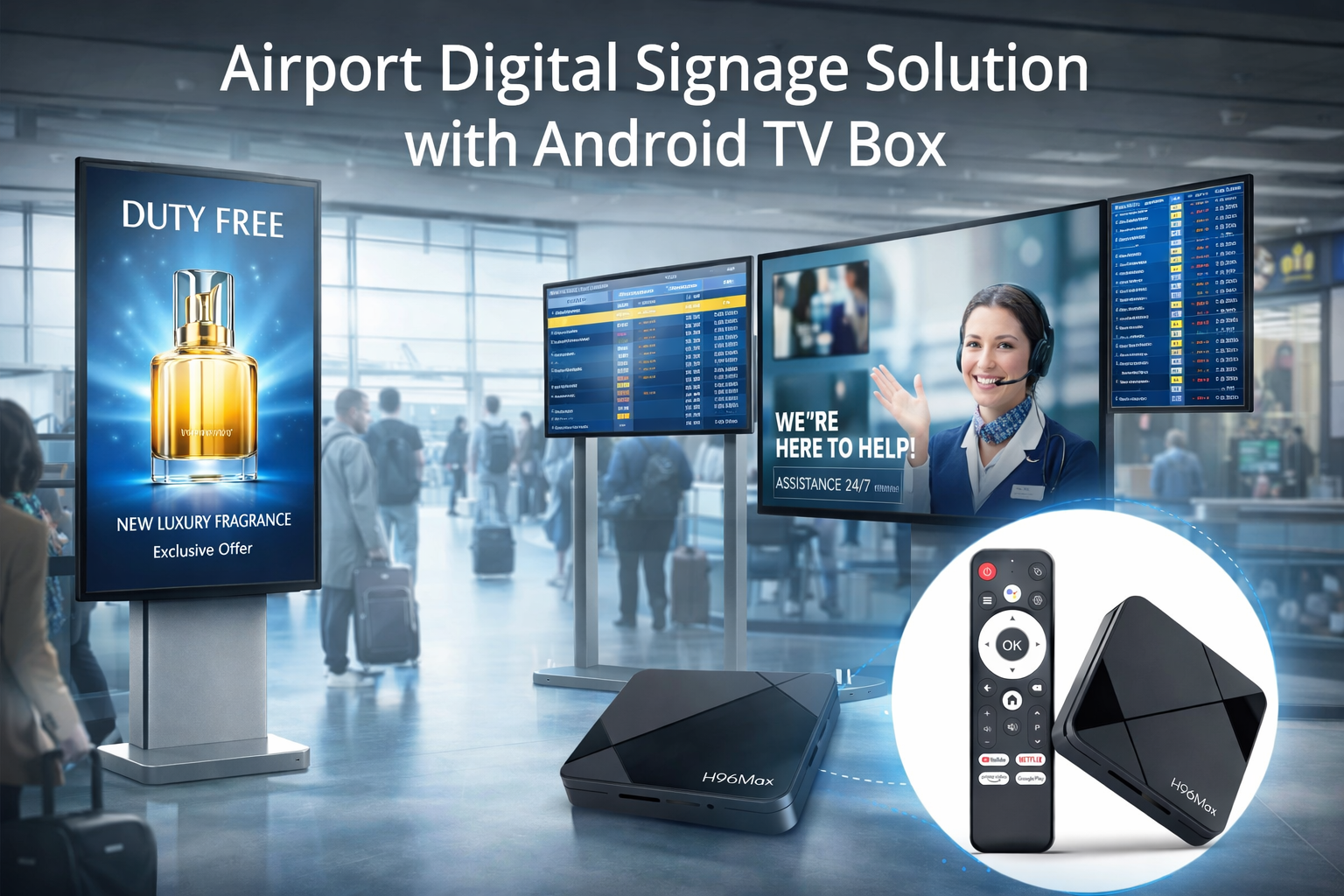
How Android TV Boxes Enable Modern Airport Information Display Infrastructure
Modern airports operate as complex transportation hubs that must deliver clear information to millions of travelers every day. From departure updates to gate changes and multilingual announcements, passengers rely heavily on visual communication systems. In recent years, the Android TV Box for Airport Digital Signage has emerged as a practical and scalable solution for airports seeking to modernize their information display infrastructure without dramatically increasing operational complexity. Instead of relying on traditional proprietary signage hardware, many airport operators are exploring Android‑based media players that can power digital screens across terminals, lounges, retail areas, and transportation corridors.
Industry analysts note that airports are under increasing pressure to improve passenger experience while managing rising operational costs. According to Airports Council International, global passenger traffic continues to grow steadily, placing pressure on airport communication systems to become faster, more accurate, and easier to manage. As a result, flexible display infrastructure built around solutions like an Android TV Box for Airport Digital Signage allows airports to deploy scalable visual communication networks capable of supporting real‑time flight information, emergency messaging, and commercial advertising simultaneously.
Why Airports Are Re‑Evaluating Their Digital Signage Infrastructure
Traditional airport signage systems were often built using expensive proprietary media players and closed hardware ecosystems. While reliable, these systems were difficult to upgrade, expensive to expand, and limited in terms of content flexibility. Today, airport operators increasingly prioritize systems that support centralized management, flexible content delivery, and seamless integration with existing airport IT infrastructure.
This shift has driven growing interest in solutions such as the Android TV Box for Airport Digital Signage, which combines the openness of the Android ecosystem with powerful media playback capabilities. Compared with legacy digital signage hardware, Android‑based systems allow airport IT teams to deploy standardized software platforms across hundreds or even thousands of screens.
Technology researchers at IDC have observed that Android‑powered digital signage players are increasingly used in transportation environments due to their compatibility with modern cloud‑based content management platforms. A well‑implemented Android TV Box Digital Signage Player can integrate with existing airport databases, enabling real‑time updates across multiple displays without manual intervention.
Flight Information Display Systems Require Real‑Time Reliability
The most critical component of any airport communication infrastructure is the Flight Information Display System (FIDS). These displays provide passengers with departure times, boarding gates, baggage claim information, and delay notifications. Accuracy and speed are essential, as even a small delay in updating a display can create confusion among travelers.
A properly configured Android TV Box for Airport Display can connect to centralized flight information databases and instantly update content across multiple screens. Because Android platforms support a wide range of network protocols and APIs, airports can integrate digital displays directly with airline and airport management systems.
The flexibility of an Android TV Box for Information Display also allows airports to customize screen layouts based on terminal requirements. For example, one display may prioritize flight schedules, while another emphasizes gate directions or baggage collection instructions. This level of customization is particularly valuable in large international airports where passenger flow patterns constantly change.
Digital Advertising Generates Important Non‑Aeronautical Revenue
Beyond operational information, airports increasingly rely on digital signage to generate commercial revenue through advertising. Airport advertising has become one of the fastest‑growing segments of the out‑of‑home media industry because it reaches a highly valuable audience—international travelers with significant purchasing power.
A Commercial Android TV Box can support high‑resolution video playback, dynamic content scheduling, and targeted advertising campaigns. By combining flight information displays with advertising networks, airports can maximize screen utilization while maintaining essential passenger communication.
Research from PwC indicates that non‑aeronautical revenue now accounts for nearly 40 percent of total airport income in many global hubs. Digital advertising screens located near boarding gates, duty‑free stores, and security checkpoints represent a major part of this revenue stream. Deploying a scalable Android TV Box for Airport Digital Signage infrastructure makes it easier to manage advertising content across multiple terminals from a single control center.
Multilingual Communication Improves Passenger Experience
International airports serve travelers from dozens of countries, making multilingual communication essential. Digital signage powered by Android systems can dynamically switch languages depending on location, time of day, or passenger demographics.
For example, arrival areas may display instructions in English, Mandarin, Spanish, and Arabic, while domestic terminals prioritize local languages. An Android TV Box for Digital Signage enables flexible language configuration because Android supports diverse font systems, translation APIs, and real‑time content switching.
Transportation researchers have found that multilingual information displays significantly reduce passenger confusion, particularly during gate changes or security alerts. With an integrated Android TV Box Digital Signage Player, airport operators can instantly update instructions in multiple languages during operational disruptions.
Centralized Content Management Simplifies Operations
One of the biggest operational challenges for airport IT teams is managing hundreds of screens spread across large terminals. Without centralized control, updating content across multiple displays becomes inefficient and prone to errors.
Modern digital signage platforms solve this problem through cloud‑based management systems. When paired with an Android TV Box for Airport Digital Signage, these platforms allow administrators to remotely schedule content, monitor device health, and push updates across entire display networks.
Remote device management also enables airports to perform software updates and security patches without physically accessing each screen. This capability is especially valuable in high‑traffic environments where physical access to displays may be restricted.
Scalable Architecture Supports Future Expansion
Airport infrastructure must be designed for long‑term growth. Passenger traffic forecasts from IATA suggest that global air travel could double within the next two decades. As airports expand terminals and add new gates, digital signage networks must scale accordingly.
Because Android‑based media players are relatively compact and cost‑efficient, deploying additional screens powered by an Android TV Box for Airport Digital Signage becomes significantly easier compared with proprietary signage hardware.
IT teams can replicate standardized configurations across new displays, ensuring consistent user interfaces and centralized control. This modular approach is one of the reasons many system integrators consider Android solutions when evaluating how to build airport digital signage system with android tv box architectures.
Evaluating the Best Hardware for Airport Deployments
When selecting hardware for transportation environments, reliability and performance are critical. Airports operate 24 hours a day, which means signage players must deliver stable playback and consistent connectivity.
The best android tv box for airport digital signage system deployments typically includes features such as powerful processors, hardware video decoding, secure remote management, and industrial‑grade thermal design. These characteristics ensure that screens remain operational even under heavy workloads and continuous use.
Industry integrators often deploy redundant content servers and network monitoring tools alongside Android media players to maintain high uptime across airport display networks.
Why the Android Ecosystem Continues to Grow in Digital Signage
Another reason Android signage platforms continue gaining popularity is the massive global developer ecosystem. With millions of developers building applications for Android devices, airports benefit from a wide selection of compatible software tools and integrations.
This ecosystem supports innovative features such as AI‑powered passenger analytics, queue monitoring, and interactive wayfinding systems. As these technologies evolve, the flexibility of the Android TV Box for Airport Digital Signage ensures that airports can adopt new capabilities without replacing their entire hardware infrastructure.
For airport operators planning long‑term digital transformation strategies, open platforms provide an important advantage over proprietary hardware systems that may limit innovation.
Looking Ahead: The Future of Airport Communication Systems
Airports are rapidly evolving into data‑driven smart transportation hubs. Digital displays now serve as essential tools for passenger guidance, commercial engagement, and operational efficiency. As airport networks continue expanding, scalable technologies will play an increasingly important role in delivering consistent communication experiences.
Solutions built around the Android TV Box for Airport Digital Signage offer a practical pathway toward more flexible, centralized, and future‑ready airport display infrastructure. By combining real‑time information distribution with advertising capabilities and multilingual communication, Android‑based signage platforms help airports meet both operational and commercial objectives.
Organizations exploring new digital signage strategies often collaborate with experienced hardware partners to ensure stable deployment and long‑term reliability. For airport operators, system integrators, and transportation technology providers seeking scalable Android signage solutions, partnering with trusted manufacturers can accelerate project implementation.
Partner with H96 Max today to explore reliable Android‑based hardware platforms designed for modern digital signage ecosystems.
READ MORE
How Content Platforms Can Launch Subscription Services Through Android TV Boxes?
How to Build a Digital Signage System Using an Android TV Box?
How Can Schools Use Android TV Boxes for Campus Television Networks?
How Sports Bars Deliver Streaming Entertainment with Android TV Boxes?
How Mall Advertising Screen Systems Achieve Centralized Management with Android TV Boxes?
How to Build a Community TV Network Using an Android TV Box?
How Smart Home Platforms Use Android TV Boxes to Build a Home Entertainment Center?
Quick Links

.png "Watch H96 Max Android TV Box reviews on our YouTube channel")

.png "Explore H96 Max product photos on Instagram")