.png "H96 Max Android TV Box video reviews and tutorials on YouTube")
.png "H96 Max Android TV Box photos and lifestyle shots on Instagram")



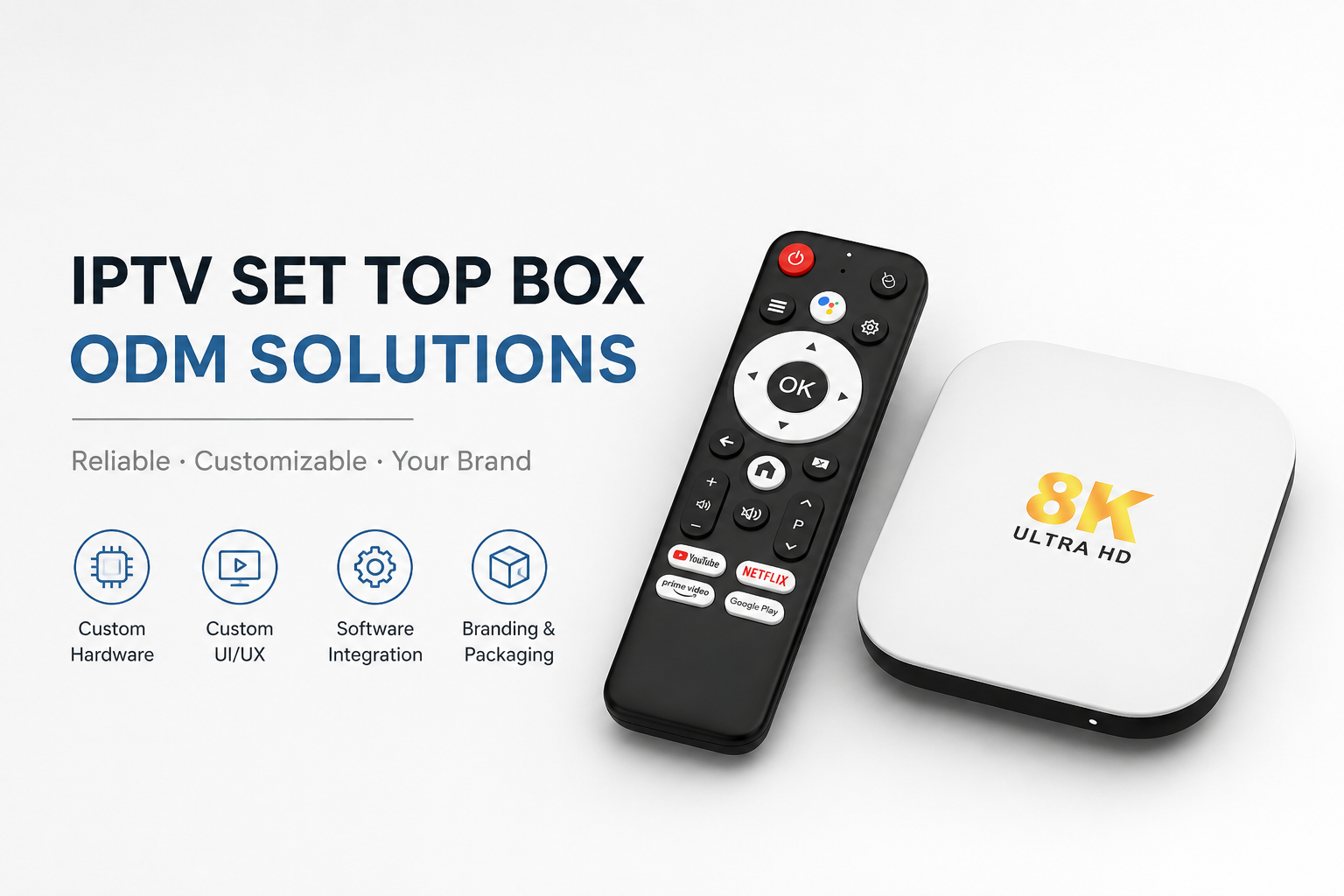
Which Hardware Specifications Actually Matter in a B2B IPTV Box?
A strong IPTV Set Top Box Manufacturer should help B2B buyers translate service requirements into hardware architecture instead of encouraging a specification race. Brands, importers, wholesalers, distributors, operators and OEM/ODM procurement teams often compare SoC names, RAM and storage first, yet real deployment quality also depends on video pipelines, network stability, thermal margin, interfaces, power design and component lifecycle. A box with impressive headline specifications can still perform poorly when Wi-Fi is congested, the enclosure traps heat, storage quality varies or the selected platform cannot support the required software roadmap. Hardware procurement should therefore begin with workloads and operating conditions, then define measurable acceptance criteria. This guide explains how buyers can specify a commercially balanced IPTV set top box without paying for features that do not improve customer experience or underengineering the functions that determine field reliability.
Start With Workloads Instead of a Chipset Name
Define what the product must actually do: video resolution, codecs, simultaneous applications, launcher complexity, middleware, DRM requirements, peripherals and expected software lifetime. These inputs determine processing needs more reliably than choosing a processor because it appears newer.
Ask the IPTV Set Top Box Supplier to demonstrate representative workloads on production-intent hardware. Benchmarks can provide context, but application launch, playback, navigation and recovery behavior under realistic conditions matter more to customers.
How Should Buyers Evaluate the SoC?
The SoC combines CPU, GPU, video processing and other platform functions. Evaluate codec support, display output, software maturity, thermal behavior, upstream support and availability. A technically powerful SoC is not automatically the best commercial platform.
A capable IPTV Set Top Box Manufacturer should explain why a proposed SoC fits the use case and what software dependencies accompany it. Buyers should also understand the migration path if the chipset later reaches end of life.
Video Capability Needs End-to-End Validation
Codec support on a data sheet does not prove that every required stream will behave correctly. Test representative content with expected bitrates, containers, frame rates, audio formats and applications. Include seeking, long playback and switching scenarios.
For operator deployments, test actual service workflows where commercially and technically possible. Playback performance can depend on application, middleware, DRM, network conditions and firmware in addition to hardware decoding capability.
How Much RAM Is Enough?
RAM should be sized for the operating system, launcher, middleware and applications with adequate margin. More memory can improve multitasking, but unused capacity increases BOM cost without necessarily improving the user experience.
A Custom IPTV Set Top Box Manufacturer should profile representative software rather than recommend RAM solely from market trends. Test cold boot, repeated app launches, background processes and long-duration use to identify pressure or leaks.
Storage Capacity Is Only Half the Question
Storage must accommodate the system image, updates, applications, caches, logs and expected user data. Leave sufficient operational margin so a device does not become unstable after months of normal use.
The IPTV Set Top Box Manufacturer should also control storage component quality and substitutions. Capacity labels alone do not describe endurance, performance or firmware compatibility. Proposed alternatives should be qualified before entering volume production.
Why Is Ethernet Still Important?
For managed IPTV environments, wired Ethernet can provide predictable connectivity where installation permits it. Define required link speed and verify sustained application behavior rather than assuming the connector automatically delivers expected performance
Check connector quality, PCB implementation and firmware behavior during link negotiation, standby and recovery. Operators should test the box with representative switches, routers and network policies from the intended deployment.
Wi-Fi Should Be Specified by Environment
Wireless performance depends on access points, interference, distance, antennas, enclosure materials and client population. Simply requesting a Wi-Fi generation does not define the experience. Describe expected environments and performance targets.
An IPTV Set Top Box Manufacturer should validate throughput, stability and recovery using the final antenna and enclosure configuration. Test both favorable and difficult conditions, including coexistence with other radios where relevant.
Antenna Design Can Undermine Good Silicon
A high-quality wireless chipset cannot compensate for poor antenna placement. Mechanical structures, PCB ground, cables and nearby components can influence performance. This is why enclosure and radio engineering should progress together.
If industrial design changes after wireless tuning, reassess the finished configuration. Cosmetic revisions that move vents, metal features or internal parts may have technical consequences invisible in a rendering.
When Does Bluetooth Matter?
Bluetooth may support remotes, audio devices, game controllers or other peripherals. Define required profiles and simultaneous-use scenarios. Test pairing, reconnection, standby recovery and coexistence with Wi-Fi under realistic conditions.
An OEM IPTV Set Top Box Manufacturer should validate the exact remote and peripheral combinations planned for sale. A generic Bluetooth demonstration is insufficient when the commercial product depends on a specific accessory workflow.
Choose I/O From the Deployment Workflow
USB, HDMI, audio, Ethernet and other interfaces should correspond to actual use cases. Every connector adds BOM, PCB area, enclosure openings and potential support questions. Removing an unused interface can be better value than advertising more ports.
Conversely, a required service port or peripheral interface should not be removed merely to reach a target price. Procurement should classify interfaces as mandatory, optional or unnecessary before quotation comparison.
HDMI Performance Requires System Testing
Test the finished product with representative televisions, receivers and cables. Verify required resolutions, refresh rates, audio behavior, hot-plug events, standby and wake. Compatibility problems often appear only in combinations absent from engineering benches.
For Wholesale IPTV Set Top Box programs serving diverse consumers, a broader display test matrix can reduce support exposure. Record known limitations rather than assuming every display behaves identically.
Thermal Design Protects Performance and Lifetime
Compact boxes operate for long periods and can experience warm rooms or restricted ventilation. Thermal design should consider SoC load, power components, enclosure geometry, heat spreaders and airflow rather than relying on a short desktop test.
Ask the IPTV Set Top Box Manufacturer for temperature and stability evidence under sustained representative workloads. Test in realistic ambient conditions and confirm that thermal management does not create unacceptable performance degradation.
The Power Adapter Is Part of the System
Specify voltage, current, connector, plug type and regional requirements for the external adapter. Low-quality power can create resets, noise or premature failures that appear to be box defects.
Control approved adapter models by SKU. If sourcing proposes an alternative, review electrical behavior, physical compatibility and applicable market requirements before substitution. Similar printed ratings do not guarantee equivalent performance.
Remote Hardware Deserves Engineering Attention
Button feel, layout, infrared performance, Bluetooth behavior, microphone requirements and battery design influence daily experience. Operators should consider service-specific shortcuts, while retail brands may prioritize intuitive navigation across applications.
Test the remote with the final launcher and firmware. Hardware and software teams should jointly approve key mapping, pairing, wake behavior and long-press actions so the interface behaves consistently.
Do You Need a Custom PCB?
A custom PCB is justified when standard platforms cannot satisfy required dimensions, interfaces, radio architecture or other critical constraints. It can create strong differentiation but increases engineering, prototype and validation work.
A mature IPTV Set Top Box Manufacturer should first identify whether configuration changes on an existing board solve the requirement. Reusing a proven architecture can shorten launch time and preserve known manufacturing performance.
Control the BOM Without Freezing Innovation
Identify critical components and approved alternatives. Require notification before changes to memory, storage, wireless modules, adapters or other parts that can affect performance, software or regulatory evidence.
Change control does not mean rejecting every substitution. It means the buyer understands the proposal, engineering evaluates consequences and validation confirms equivalence before the revised configuration reaches customers.
Design for Component Lifecycle
Ask about availability expectations for the SoC, memory, wireless solution and specialized components. Long-lived operator projects should prioritize platforms with credible support and migration plans rather than optimizing only initial purchase cost.
When a critical component approaches end of life, early notice allows qualification of an alternative or successor product. Emergency redesign after supply disappears is far more disruptive than planned migration.
Use Engineering Samples in Stages
Early samples can validate architecture and performance before expensive mechanical commitments. Later samples should confirm the production-intent PCB, enclosure, antennas, adapter, remote and firmware. Label every sample by revision.
Define what each round must prove. This prevents buyer teams from spending time reviewing cosmetic details on hardware that exists only to test a technical concept.
Build a Hardware Validation Matrix
Create tests for boot, video, networking, ports, storage, standby, wake, remote, peripherals, thermal behavior and power recovery according to the intended product. Record pass criteria and test configuration.
The IPTV Set Top Box Manufacturer and buyer should share critical acceptance criteria before pilot production. Objective tests reduce disagreements and make later component-change validation much faster.
Do Not Forget Production Testability
A design that works in engineering must also be testable at manufacturing speed. The factory needs reliable methods to verify ports, network functions, firmware, remote behavior and other required functions on every appropriate unit.
Review production fixtures and test coverage during pilot runs. Track first-pass yield and recurring failures. Good testability helps prevent latent assembly defects from becoming expensive field returns.
Balance Hardware Cost With Field Cost
A small BOM reduction is attractive only if it preserves required performance and reliability. Calculate potential savings against support, returns, replacement logistics and reputation costs if a lower-cost component increases failure exposure.
For high-volume deployments, modest improvements in stability can have meaningful operational value. Procurement should therefore evaluate total lifecycle economics rather than rewarding the lowest component cost in isolation.
What Does a Strong Hardware Specification Look Like?
A strong specification links every major hardware choice to a user, deployment or lifecycle requirement. It defines measurable acceptance criteria, approved configurations and change-control rules while leaving room for qualified alternatives.
Working with an IPTV Set Top Box Manufacturer this way gives B2B buyers a more predictable product than simply selecting the longest specification sheet. Engineering discipline becomes part of procurement value.
Discuss Your Hardware Requirements With H96 Max
H96 Max is a source factory supporting brands, importers, wholesalers, distributors, operators and OEM/ODM procurement teams. We can discuss IPTV set top box platform selection, SoC and memory configurations, storage, wired and wireless networking, interfaces, enclosure requirements, remotes, firmware integration, pilot production and repeat-order control. Share your target markets, applications, deployment environment, expected volume and required hardware differentiation so the configuration can be reviewed against real business needs before development is committed. Partner with H96 Max today to explore a hardware program built around practical engineering, controlled manufacturing and scalable B2B supply.
READ MORE
How to Structure an IPTV Set Top Box Manufacturing Agreement for B2B Buyers
How to Manage IPTV Set Top Box Fleets After Large-Scale Deployment
How to Plan IPTV Set Top Box Compliance for International B2B Markets
How to Calculate the True Cost of Bulk IPTV Set Top Box Procurement
How B2B Buyers Can Audit IPTV Set Top Box Quality Before Mass Production
How to Reduce IPTV Set Top Box Supply Chain Risk Before Bulk Orders
How to Control IPTV Set Top Box Software Before Mass Deployment
OEM vs ODM: Which IPTV Set Top Box Manufacturing Model Fits Your Business?
How to Choose an IPTV Set Top Box Manufacturer for B2B Procuremen
Quick Links

.png "Watch H96 Max Android TV Box reviews on our YouTube channel")

.png "Explore H96 Max product photos on Instagram")