.png "H96 Max Android TV Box video reviews and tutorials on YouTube")
.png "H96 Max Android TV Box photos and lifestyle shots on Instagram")



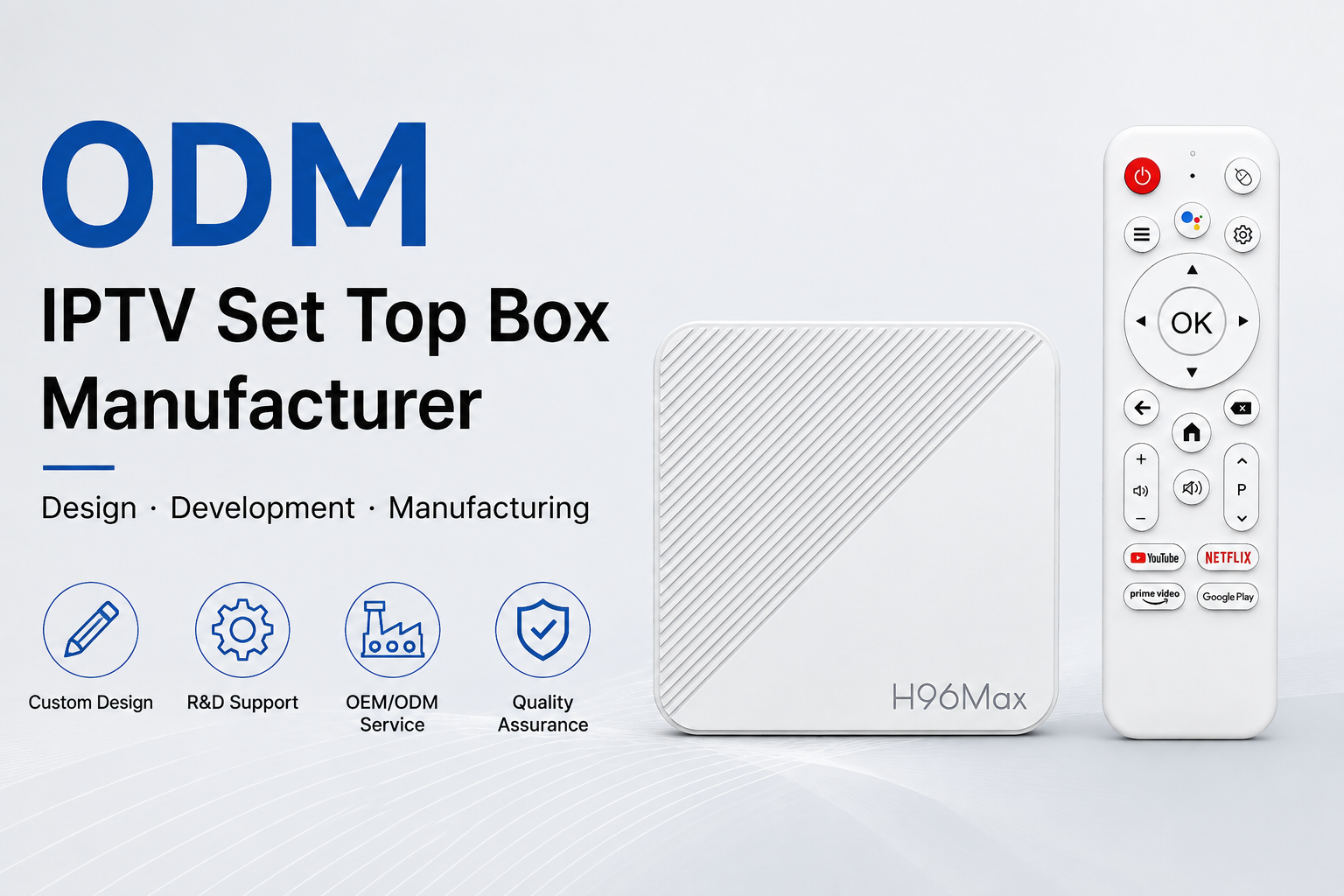
Should Your IPTV Box Project Use OEM, ODM or Private Label?
For many B2B buyers, choosing an IPTV Set Top Box Manufacturer begins with a deceptively simple question: should the project use an existing platform, an OEM customization package or a deeper ODM development model? The wrong answer can create unnecessary tooling, engineering fees and schedule risk, while an overly standard product may fail to differentiate a brand or satisfy an operator's technical requirements. Brands, importers, wholesalers, distributors and service providers should therefore choose the development model according to business value rather than terminology. The most effective procurement process identifies which product layers genuinely need differentiation, which can remain standardized, and how much engineering ownership the buyer needs over the product lifecycle. This guide provides a decision framework for matching customization depth to commercial goals without paying for complexity that customers do not value.
First Define What OEM, ODM and Private Label Mean for Your Project
Supplier terminology is inconsistent, so define deliverables instead of relying on labels. Private label commonly means an existing hardware platform with buyer branding, packaging and limited software changes. OEM may add broader configuration, while ODM can involve engineering changes to hardware, mechanics or software.
Ask an OEM IPTV Set Top Box Manufacturer to describe exactly what is standard and what is developed specifically for you. A written scope prevents both parties from interpreting “custom” differently after the purchase decision.
When Is Private Label the Rational Choice?
Private label can be commercially strong when speed, low development exposure and proven hardware matter more than unique architecture. Importers entering a new region and distributors testing demand may benefit from using a mature platform before investing in deeper customization.
The buyer can still differentiate through packaging, remote artwork, boot assets, launcher configuration and channel strategy. Standardization is not automatically a weakness; it can preserve engineering maturity while allowing commercial teams to validate demand.
When Does OEM Create More Value?
OEM becomes useful when an existing platform meets the core technical requirement but needs meaningful buyer-specific configuration. This might include memory options, ports, accessories, launcher behavior, application integration, remote mapping or regional packaging.
A capable IPTV Set Top Box Manufacturer should distinguish configuration from architecture changes. Buyers gain differentiation without reopening every engineering decision, which can create a favorable balance between time to market and product control.
When Is True ODM Development Justified?
Deeper ODM is justified when the business case depends on requirements that existing platforms cannot satisfy efficiently. Examples include a unique enclosure, specialized I/O, different thermal constraints, operator-specific peripherals, custom board dimensions or substantial platform software integration.
A Custom IPTV Set Top Box Manufacturer should translate those requirements into engineering work packages, validation activities and non-recurring costs. ODM is valuable when the resulting capability creates commercial advantage large enough to justify that investment.
Use Customer Value to Decide What to Customize
List every proposed customization and ask what customer problem it solves. A unique enclosure may strengthen retail branding, while an operator may value remote ergonomics, managed provisioning or stable network behavior much more than external appearance.
If a feature does not improve revenue, deployment efficiency, support cost, channel access or defensible differentiation, question whether it deserves engineering effort. This keeps the project focused on outcomes rather than a long wishlist.
Map Customization by Product Layer
An IPTV Set Top Box Manufacturer should help buyers map customization across hardware, enclosure, firmware, launcher, applications, remote, accessories and packaging. Each layer has different cost, lead time and validation consequences.
A logo change is not equivalent to a PCB change. Likewise, modifying a launcher theme is different from altering Android framework behavior. Separating layers makes quotations clearer and helps management decide where uniqueness is worth maintaining.
How Much Hardware Control Do You Really Need?
Start with workload and interfaces rather than demanding the newest chipset. Define video requirements, memory, storage, wireless environment, Ethernet, USB, HDMI, audio and peripheral needs. Then compare these requirements with stable factory platforms.
Custom PCB work can solve genuine constraints, but it also creates new engineering and validation. If a standard board meets the use case, retaining it may reduce development risk and make future component substitutions easier to manage.
Treat the Enclosure as an Engineering Decision
Industrial design affects more than appearance. Ventilation, antenna placement, connector access, assembly and tooling all interact. A custom enclosure should be reviewed by mechanical, thermal and wireless engineers before tooling release.
For lower-volume programs, consider whether color, surface treatment or branding on an existing enclosure provides sufficient differentiation. Tooling economics improve as lifetime volume rises, so expected demand should influence the decision.
Decide the Software Architecture Before Asking for Features
Software requests can create long-term maintenance obligations. Define whether the product needs a customized launcher, preloaded applications, device management, remote configuration, OTA updates or deeper framework changes.
The IPTV Set Top Box Supplier should explain which features use standard platform capabilities and which require a separate code branch. Every permanent branch adds regression work, release management and future support complexity.
Clarify Android Ecosystem Requirements
If Android is required, distinguish an AOSP-based product from one requiring particular Google services or other licensed ecosystems. Google's Android Compatibility Definition Document establishes requirements for compatible Android implementations, while specific services can involve additional agreements and qualification.
An IPTV Set Top Box Manufacturer should never substitute vague “Android certified” language for a precise explanation of the proposed software model. Buyers should verify required services, rights and qualification paths with the relevant authorized parties.
Make the Remote Part of the Product Strategy
The remote is often the user's primary interface. Button layout, infrared or Bluetooth behavior, voice requirements, key mapping, pairing and branding should be defined according to the service experience.
A custom remote may require tooling and additional validation, while an existing remote can shorten launch time. Test the complete remote-plus-launcher workflow rather than approving these elements independently.
Understand How MOQ Changes With Customization
Customization can create different minimum quantities for electronics, enclosure finishing, remotes, labels and cartons. For Wholesale IPTV Set Top Box programs, ask which material actually drives each MOQ.
This enables smarter launch structures. Common hardware might be purchased in one quantity while market-specific packaging is released in smaller batches, reducing finished-goods exposure without forcing the factory into uneconomic production.
Model NRE and Tooling Against Lifetime Volume
Non-recurring engineering and tooling should be evaluated against realistic lifetime demand, not only the first order. Divide upfront investment across conservative volume scenarios and compare the result with the margin or strategic value created by customization.
An IPTV Set Top Box Manufacturer should identify NRE, molds, prototypes and other setup costs separately from recurring unit price. This makes the financial tradeoff visible to decision-makers.
Protect the Schedule With Progressive Design Freezes
Freeze high-impact architecture decisions first, followed by mechanical design, firmware baseline, artwork and packaging. Late changes become increasingly expensive because more downstream work has already been completed.
When a change is proposed, assess engineering, material, testing and schedule impact before approval. A disciplined change process preserves flexibility without allowing the project to become an endless development cycle.
Build Prototypes Around Decisions
Every sample should answer a question. Early engineering units may validate platform performance, while later samples confirm enclosure, software, remote and production configuration. Identify hardware and firmware revisions on every unit.
Consolidate buyer feedback by sample round. Mixing comments from different revisions can cause engineers to investigate issues already fixed or overlook defects introduced by a newer build.
Do Not Let Customization Bypass Quality Gates
A custom product needs more validation, not less. Define acceptance criteria for required interfaces, network performance, applications, remote functions, standby, thermal behavior and packaging according to the actual use case.
Before volume production, the IPTV Set Top Box Manufacturer should run a production-intent pilot using approved materials, firmware and work instructions. Track yield and defects to verify that customization can be reproduced consistently.
Plan Market Access Before Freezing the Design
Target countries can affect radio, safety, EMC, labeling, documentation and other obligations. Buyers should obtain qualified regulatory advice early and identify which requirements apply to the exact configuration.
Wireless modules, antennas, adapters and enclosure changes can affect technical evidence. Formal assessment should use a stable design, while early engineering reviews help prevent expensive discoveries near launch.
Define Ownership of Custom Deliverables
For buyer-funded work, clarify ownership or usage rights for industrial design, artwork, software assets, tooling and other deliverables where appropriate. Also define confidentiality for credentials, server details, application packages and product roadmaps.
These terms are easiest to agree before development begins. Ambiguity becomes more difficult after both parties have invested time and the product has commercial value.
Plan for Component and Platform Changes
No electronic platform lasts forever. Ask how the supplier handles component discontinuation, substitutions, chipset lifecycle and successor platforms. A custom architecture can increase migration effort if it depends heavily on unique parts.
A well-designed program preserves common interfaces and software behavior where possible. This makes future transitions less disruptive for applications, packaging, support teams and channel partners.
Compare Development Models With a Decision Scorecard
Score private label, OEM and ODM against differentiation, engineering cost, launch time, MOQ, validation burden, lifecycle maintenance and migration risk. Weight each factor according to the business model rather than applying one generic sourcing formula.
For a market test, speed and low inventory exposure may dominate. For a large operator deployment, software control and long-term configuration stability may justify greater upfront engineering.
What Is the Best Customization Strategy?
The best strategy is the minimum customization required to create the intended business advantage. An IPTV Set Top Box Manufacturer should help preserve mature platform elements while engineering only the layers that genuinely need to be different.
This approach reduces cost and schedule risk without forcing buyers into commodity products. It also makes future support easier because fewer unique elements must be maintained across the product lifecycle.
Discuss the Right Development Model With H96 Max
H96 Max is a source factory supporting brands, importers, wholesalers, distributors, operators and OEM/ODM procurement teams. We can discuss existing IPTV box platforms, private-label programs, hardware configuration, enclosure development, firmware and launcher customization, remote controls, packaging, pilot production and repeat-order planning. Share your target market, applications, expected volume, required differentiation and launch schedule so the appropriate development depth can be evaluated before unnecessary engineering is committed. Partner with H96 Max today to explore an IPTV set top box program designed around practical customization, controlled manufacturing and scalable B2B supply.
READ MORE
How to Structure an IPTV Set Top Box Manufacturing Agreement for B2B Buyers
How to Manage IPTV Set Top Box Fleets After Large-Scale Deployment
How to Plan IPTV Set Top Box Compliance for International B2B Markets
How to Calculate the True Cost of Bulk IPTV Set Top Box Procurement
How B2B Buyers Can Audit IPTV Set Top Box Quality Before Mass Production
How to Reduce IPTV Set Top Box Supply Chain Risk Before Bulk Orders
How to Control IPTV Set Top Box Software Before Mass Deployment
How to Choose an IPTV Set Top Box Manufacturer for B2B Procuremen
Quick Links

.png "Watch H96 Max Android TV Box reviews on our YouTube channel")

.png "Explore H96 Max product photos on Instagram")